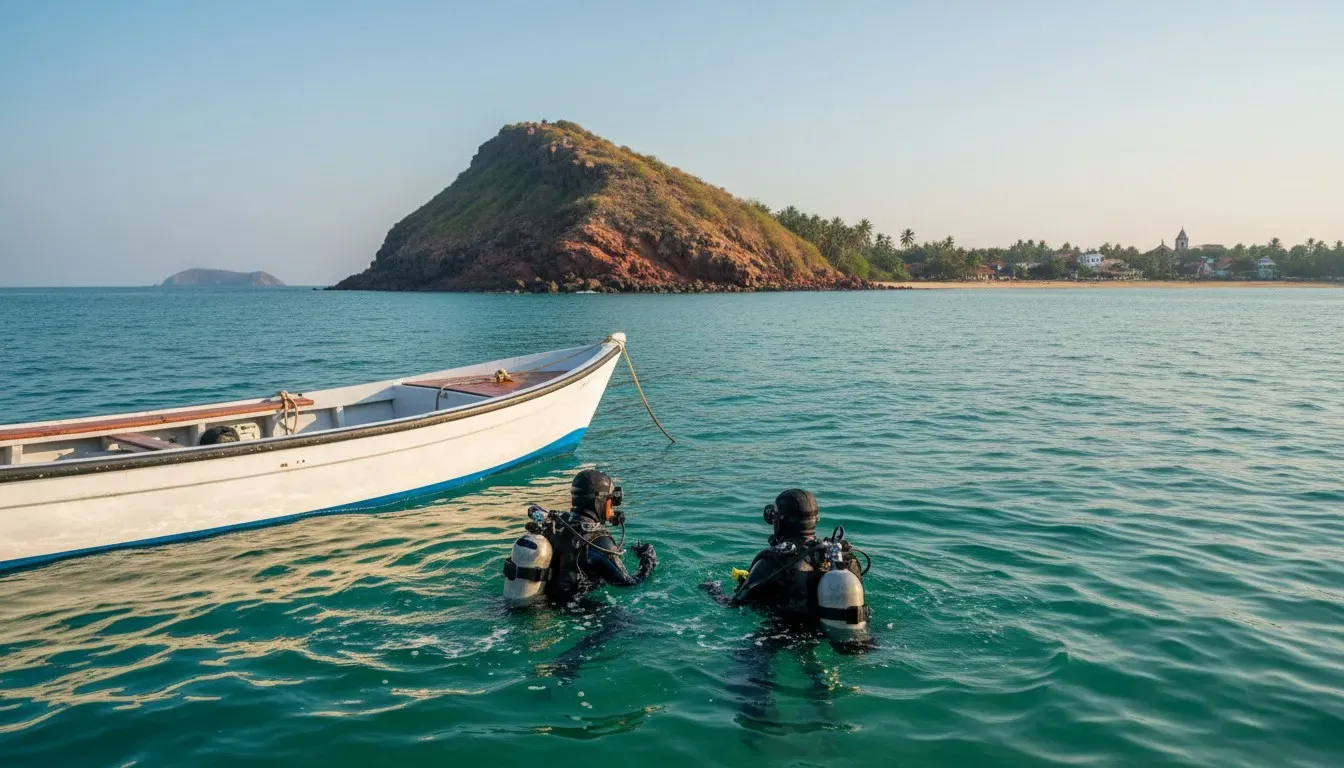


Recreational diving in Goa caters to both beginners and certified divers. Non-swimmers can complete introductory discovery dives accompanied one-on-one by an instructor down to a maximum depth of 12 metres, while certified divers have access to shallow coral patches, marine life reefs, and mid-twentieth-century shipwrecks at depths up to 24 metres.
This guide covers the primary dive sites around Grande Island, departure jetties in North and South Goa, current package pricing, certification courses, medical requirements, and decompression safety guidelines for your Goa itinerary.
Grande Island Dive Sites: Wrecks, Reefs, and Pinnacles
Commercial recreational scuba diving began in Goa in 1993. Most diving takes place around Grande Island, where depths range from 4 to 24 metres. Water temperatures remain between 27°C and 30°C throughout the operational season, with underwater visibility typically varying between 3 and 15 metres.
The seabed around the island holds significant maritime heritage. Marine archaeologists from the National Institute of Oceanography (NIO) in Dona Paula excavated a 17th-century Portuguese shipwreck off nearby Sunchi Reef, uncovering cast-iron guns and porcelain, while 19th-century industrial terracotta roofing tiles inscribed "Basel Mission Tile Works 1865" were documented at St. George’s Reef.
Today, recreational operators take divers to several recognized underwater sites around Grande Island and nearby Pequeno Island:
- Suzy’s Wreck: The bow and midsection of the SS Rita, a 130-metre British-built cargo steamship laden with railroad steel that sank in the 1950s. Located off the southwest shore at depths between 3 and 15 metres, it is suitable for beginners and open-water divers.
- Davy Jones Locker: Situated approximately 600 metres from Suzy's Wreck at depths between 12 and 18 metres (and up to 30 metres along the shelf), this site contains the severed stern and propeller of the SS Rita. Strong currents restrict this site to certified advanced divers.
- Shelter Cove: A calm, protected bay on the northeast lee side of the island with depths of 4 to 8 metres. It features sandy bottoms, coral patches, triggerfish, parrotfish, and snappers.
- Uma Guma Reef: Located on the sheltered side of the island at depths of 6 to 14 metres, offering reef formations with resident reef fish and moray eels.
- Sail Rock: An exposed rock pinnacle southwest of Grande Island where depths drop to between 10 and 24 metres. It has strong currents and attracts pelagic species, including barracuda, tuna, and eagle rays.
- Pequeno Island (Bat Island): Positioned roughly 1 kilometre off Baina Beach in Vasco da Gama, featuring shallow fringing reefs between 2 and 7 metres, primarily utilized for introductory training and snorkeling.
| Dive Site | Depth Range | Diver Qualification | Key Marine Features |
|---|---|---|---|
| Suzy’s Wreck (SS Rita) | 3 to 15 m | Introductory & Certified | Cargo steamship bow, rail tracks, reef fish |
| Shelter Cove | 4 to 8 m | Beginner / Non-swimmer | Sand floor, mild currents, parrotfish, coral |
| Uma Guma Reef | 6 to 14 m | Open Water Certified | Patch reefs, triggerfish, snappers |
| Davy Jones Locker | 12 to 18 m (up to 30 m) | Advanced Certified | SS Rita stern section, large propeller, currents |
| Sail Rock | 10 to 24 m | Advanced Certified | Pinnacle drop-off, barracuda, tuna, rays |
| Pequeno Island | 2 to 7 m | Snorkelers & Training | Shallow fringing coral reef, calm water |
Scuba Diving Packages and Certification Costs
Introductory dives do not require prior swimming ability or scuba certification. First-time divers complete an orientation, gear briefing, and a 45- to 60-minute confined-water training session in a pool before heading out by boat to Grande Island. At the dive site, non-certified participants complete an open-water dive lasting 15 to 40 minutes, held continuously one-on-one with a qualified instructor to a maximum depth of 12 metres.
There is no government admission fee to enter the waters around Grande Island, but access requires booking through a licensed operator registered under the Goa Registration of Tourist Trade Act. Operators provide boat transit, tanks, weights, gear rental, and light refreshments.
| Package Type | Price Range | Duration | Prerequisites |
|---|---|---|---|
| Introductory Single Dive (Independent Operators) | ₹1,500 – ₹4,500 per person | Full day (6–8 hours) | None (Non-swimmers allowed; min. age 10) |
| SSI Try Scuba / DSD (Official GTDC Partner) | ₹2,970 – ₹2,990 + taxes | Full day (pool + sea dive) | None (Min. age 10) |
| Two-Tank Guided Boat Trip (Certified Divers) | ₹3,500 – ₹6,000 + GST | Morning trip (2 boat dives) | PADI / SSI Open Water certification |
| Open Water Diver Certification Course | ₹23,000 – ₹35,000 + GST | 3 to 4 days | 200 m swim + 10 min float test (Min. age 10) |
Departure Points: North Goa vs South Goa
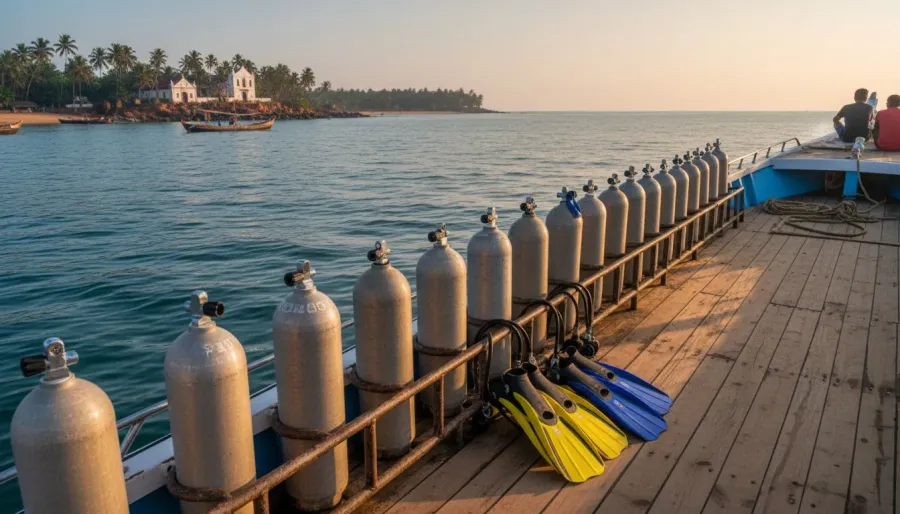
Because Grande Island is partially under Indian Navy jurisdiction, civilian tourists are not permitted to disembark or stay overnight on the island. All scuba operations are boat-based, launching from mainland jetties in the morning and anchoring in the open water off the island.
Departure locations differ based on where you choose where to stay in Goa:
**South Goa Jetties:** Dive boats depart from Baina Beach Jetty and Bogmalo Jetty in Mormugao taluka. These jetties are situated 5 kilometres (a 10- to 15-minute drive) from Vasco da Gama railway station and Dabolim Airport. The sea crossing from South Goa to Grande Island takes only 15 to 25 minutes depending on marine conditions.
**North Goa Jetties:** North Goa departures launch from Sinquerim Jetty (near Candolim) and Coco Beach Jetty in Nerul, Bardez taluka. These jetties sit 6 to 8 kilometres (a 15- to 20-minute drive) south of Calangute Beach and Baga Beach, and 12 to 14 kilometres (a 25- to 35-minute drive) west of Panaji. The boat transit across the bay from North Goa to Grande Island takes approximately 45 to 60 minutes each way (up to 90 minutes in rougher water).
Boats operate strictly during daylight hours. Trips depart the jetties between 6:30 AM and 9:30 AM and return to mainland ports between 2:00 PM and 4:30 PM.
Best Season and Underwater Visibility
The open-water diving window in Goa spans eight months, starting October 1 and concluding May 31. From June through September, the Captain of Ports and Department of Tourism enforce a total suspension of commercial open-water scuba diving due to monsoon swells, strong currents, and low visibility. For those visiting during the rainy months, alternative inland excursions like the Monsoon Adventure or Kayaking in Goa operate on sheltered inland waters.
Water visibility around Grande Island shifts across the operational season:
* **October:** The transition period following the monsoon brings recovering visibility averaging 3 to 6 metres, with water temperatures around 28°C to 30°C. * **November to February:** This is the peak scuba window. Underwater visibility reaches its seasonal best, averaging between 5 and 15 metres, with stable sea conditions and water temperatures between 27°C and 29°C. * **March to May:** Conditions remain warm with water temperatures near 29°C to 30°C. Visibility tends to drop slightly, ranging from 3 to 8 metres, as summer plankton blooms emerge before the monsoon.
Medical Requirements and Diver Safety Rules
All registered dive operators in Goa adhere to international training agency standards (such as PADI and SSI) and the Goa Registration of Tourist Trade Act. Transit boats must maintain seaworthiness clearance from the Captain of Ports or the Mercantile Marine Department.
Before taking part in any diving activity, participants must comply with mandatory safety rules:
- Age Requirements: The minimum age for introductory dives (Discover Scuba / Try Scuba) and Junior Open Water certification is 10 years. Children aged 5 to 10 may accompany adult family members on the dive boat for surface sightseeing and snorkeling, but children under 5 years of age are not permitted on offshore dive vessels.
- Non-Swimmer Protocols: Non-swimmers are fully permitted to do introductory discovery dives under a mandatory 1:1 instructor-to-diver underwater ratio to a depth limit of 12 metres. However, enrolling in an Open Water Diver certification course requires passing a continuous 200-metre surface swim and a 10-minute water float test.
- Medical Declaration: Divers must complete a Recreational Scuba Medical Questionnaire. Anyone with active asthma, cardiovascular disease, hypertension, epilepsy, or recent ear surgery requires written clearance from a medical doctor. Diving while pregnant is strictly prohibited.
- Decompression Flight Intervals: Due to decompression safety rules, you must maintain a surface interval of at least 12 hours after completing a single dive, and at least 18 hours after multiple dives, before boarding an aircraft at Dabolim Airport or Manohar International Airport.
Book with GoaWala
3 options from ₹1,000 per person — live prices, October 2026.
- Monsoon Adventure — from ₹1,000 per person · 4 Hours 30 Minutes · Panaji (Central Goa)
- Bungee Jumping Goa — from ₹2,800 per person · 1 Hour · North Goa
- Jumpin Heights Goa — from ₹4,500 per person · 1 Hour · North Goa
Frequently asked questions
Can non-swimmers do scuba diving in Goa?
Yes. Non-swimmers can participate in introductory programs such as Discover Scuba Diving or Try Scuba. You will receive confined-water training and complete an open-water dive with an instructor at a 1:1 ratio to a maximum depth of 12 metres.
How much does scuba diving cost in Goa?
Single-dive introductory packages for beginners range from ₹1,500 to ₹4,500 per person through independent operators, while official GTDC partner introductory dives cost ₹2,970 to ₹2,990 plus taxes. Guided two-tank boat trips for certified divers cost between ₹3,500 and ₹6,000 plus GST.
Where is scuba diving done in Goa?
The main scuba diving hub is Grande Island (Ilha Grande), located off the Mormugao peninsula about 4 nautical miles west of Vasco da Gama. Popular sites around the island include Suzy’s Wreck, Shelter Cove, Uma Guma Reef, and Sail Rock.
When is scuba diving closed in Goa?
All open-water commercial scuba diving is suspended during the southwest monsoon from June 1 through September 30 by order of the Captain of Ports and the Department of Tourism. Operations resume on October 1.
How many hours after scuba diving can I fly?
Standard decompression guidelines require a minimum surface interval of 12 hours after a single dive, and at least 18 hours after completing multiple dives, before flying on an aircraft.
What is the minimum age for scuba diving in Goa?
Under PADI and SSI regulations enforced in Goa, the minimum age for introductory dives or Junior Open Water certification is 10 years. Children aged 5 to 10 can join the boat as non-diving passengers for sightseeing or snorkeling, but kids under 5 are not permitted on board.
Sources
- guavatrips.com
- quora.com
- goa-tourism.org.in
- divesport.in
- wannabemaven.com
- goatourspackage.com
- scuba-diving-goa.com
- deepdivegoa.com
- seaadventuretrip.com
- mygoa365.com
- scubalov.in
- villacalangute.com
- thegoavilla.com
- seawatersports.com
- flyingfish.in
- miagoaairport.com
- scubadivingingoa.com
- goaaquatics.com
- barracudadiving.com
- indiatimes.com
Last checked 5 October 2026