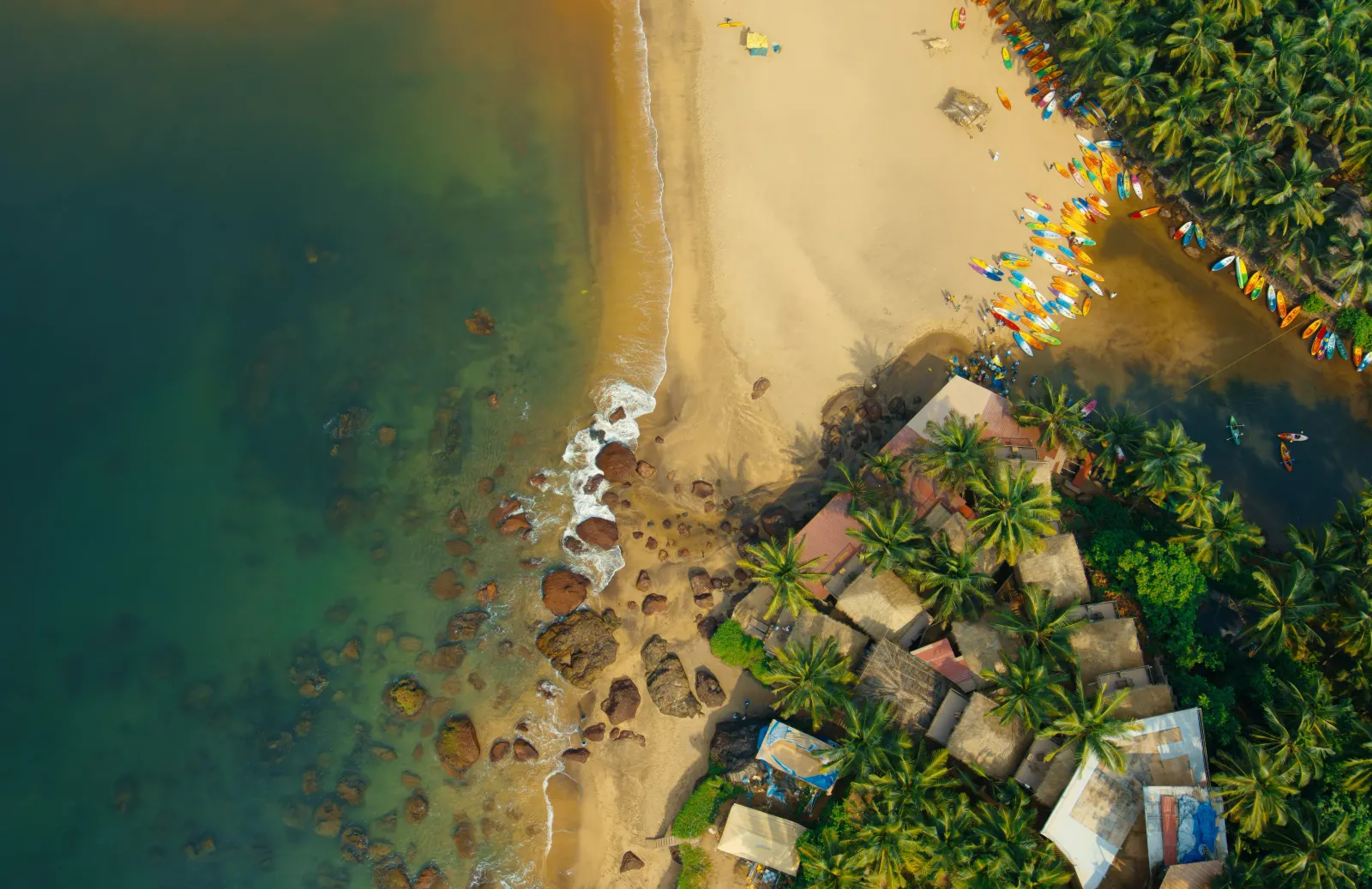


Successful trip planning in Goa depends on practical logistics: understanding airport feeder routes, knowing strict beach regulations, and timing visits to heritage sites, waterfalls, and sanctuaries. Standard app-based cabs like Uber and Ola do not operate in the state, making transit planning essential before you arrive.
This guide outlines verified transport fares, fort and monument operating hours, seasonal water sports schedules, mandatory vehicle rental rules, and statewide beach laws.
Book with GoaWala
31 options from ₹400 per person — live prices, October 2026.
- Calma Sundowner Cruise — from ₹400 per person · 1 Hour 30 Minutes · Panaji (Central Goa)
- Capital Sundowner Cruise — from ₹400 per person · 1 Hour 30 Minutes · Panaji (Central Goa)
- North Goa Tour — from ₹400 per person · 9 Hours · North Goa
- Paradise Sunset Cruise — from ₹400 per person · 1 Hour 30 Minutes · Panaji (Central Goa)
- South Goa Tour — from ₹400 per person · 9 Hours · South Goa
- Vihaan Sunset Cruise — from ₹400 per person · 1 Hour 30 Minutes · Panaji (Central Goa)
- Princesa Sunset Cruise — from ₹450 per person · 2 Hours · Panaji (Central Goa)
- Coral Dinner Cruise — from ₹850 per person · 3 Hours · Panaji (Central Goa)
- Swastik Dinner Cruise — from ₹850 per person · 3 Hours · North Goa
- Calma Dinner Cruise — from ₹900 per person · 3 Hours · Panaji (Central Goa)
- Nirvana Dinner Cruise — from ₹900 per person · 3 Hours · Panaji (Central Goa)
- Vihaan Dinner Cruise — from ₹900 per person · 3 Hours · Panaji (Central Goa)
- Monsoon Adventure — from ₹1,000 per person · 4 Hours 30 Minutes · Panaji (Central Goa)
- Paradise Dinner Cruise — from ₹1,000 per person · 3 Hours · Panaji (Central Goa)
- Paradise Dinner Cruise — from ₹1,000 per person · 3 Hours · Panaji (Central Goa)
- Princesa Dinner Cruise — from ₹1,200 per person · 3 Hours · Panaji (Central Goa)
- Extreme South Goa Tour — from ₹1,500 per person · 10 Hours · South Goa
- Bungee Jumping Goa — from ₹2,800 per person · 1 Hour · North Goa
- Jumpin Heights Goa — from ₹4,500 per person · 1 Hour · North Goa
- MANDOVI LOUNGE Boat – Up to 8 Pax — from ₹9,500 per boat · 2 Hours · Britona
- WAVE RIDER Yacht – Up to 6 Pax — from ₹10,000 per yacht · 2 Hours · Britona
- BLUE FIN Yacht - Up to 6 Pax — from ₹11,000 per yacht · 2 Hours · Britona
- THE RINKER 260EC Yacht - Up to 7 Pax — from ₹12,000 per yacht · 2 Hours · Britona
- MANTA RAY Yacht - Up to 8 Pax — from ₹13,000 per yacht · 2 Hours · Britona
- MV TARA Yacht - Up to 8 Pax — from ₹13,000 per yacht · 2 Hours · Britona
- AQUILA Yacht - Up to 10 Pax — from ₹14,000 per yacht · 2 Hours · Britona
- FUNLINER Yacht - Up to 12 Pax — from ₹15,000 per yacht · 2 Hours · Britona
- SEA RAY 330 Yacht - Up to 10 Pax — from ₹15,000 per yacht · 2 Hours · Britona
- PRESTIGE 36 Yacht - Up to 8 Pax — from ₹17,000 per yacht · 2 Hours · Britona
- MV COCO Yacht - Up to 16 Pax — from ₹19,000 per yacht · 2 Hours · Britona
- SUNSET 42 Yacht - Up to 15 Pax — from ₹25,000 per yacht · 2 Hours · Britona
Getting to Goa: Airports and Railway Stations
Goa is served by two commercial airports and two primary railway stations on the Konkan Railway network.
Manohar International Airport (GOX) at Mopa sits in Pernem taluka in North Goa, roughly 35 km north of Panaji (about a 50-minute drive) and 28 km northeast of Calangute. Dabolim Airport (GOI) is located in Mormugao taluka, approximately 28 km south of Panaji. Kadamba Transport Corporation Limited (KTCL) operates regular air-conditioned electric shuttle buses connecting both airports directly to major transit depots.
For train travellers, Thivim Railway Station (THVM) in Bardez taluka is the primary stop for North Goa, located 23 km north of Panaji and 19 km east of Calangute Beach. Madgaon Junction (MAO) in Margao serves as the principal rail hub for South Goa, situated 33 km south of Panaji.
| Hub / Route | Location / Taluka | Distance to Key Depots | KTCL AC Bus Fare |
|---|---|---|---|
| Manohar Int. Airport (GOX) | Mopa, Pernem | 35 km to Panaji / 28 km to Calangute | ₹200 to Panaji / ₹400 to Margao |
| Dabolim Airport (GOI) | Mormugao | 28 km to Panaji | ₹150 to Panaji / ₹200 to Calangute |
| Thivim Station (THVM) | Bardez | 23 km to Panaji / 19 km to Calangute | Local bus / taxi service |
| Madgaon Station (MAO) | Margao, Salcete | 33 km to Panaji | Local bus / taxi service |
Local Transit: Cabs, Apps, and Self-Drive Rentals
National cab aggregator apps Uber and Ola do not operate anywhere in Goa. Point-to-point app-based taxi bookings are limited to the state-backed GoaMiles platform and the government-operated Goa Taxi App. Pre-paid taxi booths are also available at airport terminals and railway exits.
If renting a vehicle for self-drive, state transport regulations require specific commercial registration plates. Rental cars must display black number plates with yellow lettering ("Rent-a-Cab" permit). Rental two-wheelers must display yellow number plates with black lettering. Operating a private white-plate vehicle as a commercial rental is strictly illegal and subject to police impoundment.
Public transport options include KTCL bus services linking municipal bus stands across Panaji, Mapusa, Margao, and Vasco da Gama.
- No Uber or Ola: Use the GoaMiles app or Goa Taxi App for on-demand rides.
- Rental cars: Must have black number plates with yellow lettering.
- Rental scooters and bikes: Must have yellow number plates with black lettering.
- Private white-plate rentals: Strictly prohibited; violators face vehicle impoundment.
Historical Forts and Heritage Sites
Goa came under Portuguese colonial rule in 1510 after conquest by Afonso de Albuquerque and remained under Portuguese control until December 19, 1961, when it joined India via Operation Vijay. This era left distinct architectural landmarks across the state.
Old Goa (Tiswadi taluka), located 10 km east of Panaji, houses the Basilica of Bom Jesus (containing the relics of St. Francis Xavier) and Se Cathedral (completed in 1619, featuring the historic Golden Bell). The Archaeological Museum of Goa, managed by the Archaeological Survey of India (ASI) in the convent behind the Church of St. Francis of Assisi, displays colonial artifacts. Panaji's Latin Quarter, Fontainhas, was established in the late 18th and early 19th centuries and remains a protected Conservation Zone.
Prominent coastal fortifications include Upper Fort Aguada and its 1864 lighthouse in Candolim, Chapora Fort overlooking Vagator, Reis Magos Fort across the Mandovi River, and Cabo de Rama Fort in the southern taluka of Canacona. You can explore these landmarks through organized Goa sightseeing tours, including a guided North Goa tour or South Goa tour.
| Attraction | Location | Timings | Entry Fee |
|---|---|---|---|
| Basilica of Bom Jesus | Old Goa | Mon–Sat: 09:00–18:30, Sun: 10:30–18:30 | Free entry (covered dress code) |
| Se Cathedral | Old Goa | Daily: 07:30–18:00 | Free entry |
| ASI Archaeological Museum | Old Goa | Sat–Thu: 10:00–17:00 (Closed Fri) | ₹5 to ₹20 (Free for children up to 15) |
| Upper Fort Aguada & Ramparts | Candolim | Daily: 09:00/09:30–18:00 | Ramparts free; ASI ticket ₹20 Indian / ₹250 Foreign |
| Aguad Central Jail Museum | Lower Aguada | Tue–Sun: 10:30–17:00 / Daily to 20:00 | ₹200 Domestic / ₹400 International / ₹100 Goa resident |
| Chapora Fort | Chapora / Vagator | Daily: 09:30–17:30 | Free entry |
| Reis Magos Fort | Verem | Tue–Sun: 09:30–17:00 (Closed Mon) | ₹50 Adult / ₹25 Student / ₹10 Sun & holidays |
| Cabo de Rama Fort | Canacona | Daily: 09:00–17:30 | Free entry |
| Shri Mangueshi Temple | Priol, Ponda | Daily: 06:00–12:30 & 14:30–21:30 | Free entry (shoulders & legs covered) |
Waterfalls, Bird Sanctuaries, and Wildlife Reserves
Beyond the coastline, Goa preserves dense forest cover across the Western Ghats foothills.
Dudhsagar Waterfalls is located inside Bhagwan Mahaveer Wildlife Sanctuary in Sonaulim, Dharbandora taluka, 60 km east of Panaji. Access is strictly managed: commercial 4x4 jeeps run from the Kulem railway station taxi stand from October to May. Standard rates are ₹3,500 to ₹3,920 per 7-seater vehicle (or ₹500 to ₹560 per passenger on a seat-sharing basis), plus a ₹100 Forest Department entry fee and a ₹40 life jacket rental fee. During the monsoon season (June to September), swollen river tracks force the complete suspension of vehicle safaris; access is limited to trekking routes requiring Forest Department clearance.
Dr. Salim Ali Bird Sanctuary occupies 1.8 square kilometers of mangrove swamp on Chorao Island along the Mandovi River. It is accessed by a free public vehicle-and-passenger ferry operated by the River Navigation Department from Ribandar ramp (6 km east of Panaji).
Cotigao Wildlife Sanctuary in Canacona taluka, established in 1968, features an 18-to-25-meter treetop watchtower overlooking a forest watering hole.
- Dudhsagar Jeep Safaris: Operate October to May only; closed to vehicles from June to September.
- Dudhsagar Fees: ₹3,500–₹3,920 per jeep (or shared at ₹500–₹560 per seat) + ₹100 forest entry + ₹40 life jacket.
- Dr. Salim Ali Bird Sanctuary: Open daily 06:00–18:00; ₹10 for Indians, ₹100 for foreign visitors; ferry from Ribandar is free for pedestrians and two-wheelers.
- Cotigao Wildlife Sanctuary: Open daily 07:00–17:30; entry fee ₹20 per adult, ₹10 per child, ₹75 per private car.
River Cruises and Coastal Activities
Cruising along the Mandovi River is a staple activity centered in Panaji. Authorized vessels and the Goa Tourism Development Corporation (GTDC) operate 1-hour sunset and evening cruises from the Santa Monica Jetty on Old Panaji Road, with standard departures starting around 5:30 PM and fares ranging between ₹400 and ₹500 per passenger. Popular public options include the Princesa Sunset Cruise (₹450 per person) and the Paradise Sunset Cruise (₹400 per person).
For evening dining on the water, scheduled sailings like the Calma Dinner Cruise (₹900 per person) and Princesa Dinner Cruise (₹1,200 per person) operate from Panaji. You can browse all schedules via our dinner cruise in Goa guide.
Private boat charters leave from the Britona jetty near Panaji, featuring vessels such as the MANDOVI LOUNGE Boat (₹9,500 per boat, up to 8 guests) and AQUILA Yacht (₹14,000 per yacht, up to 10 guests). Active travellers can also book inland kayaking in Goa (₹400 per person) or high-thrill activities like bungee jumping in Goa (₹2,800 per person).
State Beach Laws and Noise Regulations
Goa enforces strict municipal and tourism regulations across its coastal belt. Under the Goa Tourist Places (Protection and Maintenance) Act, consuming alcohol, cooking food, lighting bonfires, and disposing of glass bottles on public beaches outside licensed shacks are prohibited offenses. Violations carry spot fines ranging from ₹2,000 for individuals up to ₹10,000 for groups, with penalties up to ₹50,000 for illegal bonfires and open-air cooking.
Driving any motor vehicle onto the beach is completely banned across Goa under the Motor Vehicles Act and Bharatiya Nyaya Sanhita. Police impound offending vehicles immediately, with fines reaching up to ₹50,000.
Outdoor music rules are strictly applied by the Goa State Pollution Control Board and Goa Police: all open-air sound systems, beach parties, and amplified loudspeakers must shut down promptly at 22:00 (10:00 PM).
For inter-state liquor movement, Goa Excise regulations require a transit permit costing ₹20 per passenger. However, permits are not valid for direct overland transit into neighboring Karnataka or Maharashtra due to state-specific alcohol bans.
- Beach drinking: Prohibited outside licensed shacks; fines from ₹2,000 to ₹10,000.
- Driving on beaches: Strictly banned; results in vehicle impoundment and up to ₹50,000 in fines.
- Noise curfew: All outdoor music and amplified sound must cease at 22:00 (10:00 PM).
- Liquor transport: ₹20 permit required, but direct road transit into Karnataka or Maharashtra is not allowed.
- Emergency assistance: Statewide unified emergency response is 112; dedicated tourist helpline is 1364.
Seasonality and Water Safety
Goa's primary tourism and coastal operations season runs from October through May. During this window, sea conditions remain calm, seasonal beach shacks operate along the coast, and water sports providers are open.
From June 1 through September 30, the southwest monsoon brings rough seas and heavy rainfall. During these months, all sea swimming and commercial coastal water sports are suspended by maritime authorities, and temporary beach shacks are completely dismantled.
For water safety throughout the operating season, Drishti Marine lifeguards monitor more than 40 coastal stretches across North and South Goa. Always observe posted safety flags:
- Red flags: High surf and strong rip currents. Swimming is strictly prohibited. - Red-and-yellow flags: Designated safe swimming zones patrolled by lifeguards between sunrise and sunset.
Frequently asked questions
Do Uber and Ola work in Goa?
No, Uber and Ola do not operate in Goa. Point-to-point app-based taxi bookings are limited to the GoaMiles app and the government-managed Goa Taxi App, alongside fixed prepaid counters at airport and railway terminals.
What number plates should rental cars and bikes have in Goa?
Legally authorized self-drive rental cars must have black number plates with yellow lettering. Rental motorcycles and scooters must have yellow number plates with black lettering. Driving a white-plate private vehicle on rent is illegal and subject to impoundment.
Is drinking alcohol permitted on Goa beaches?
No. Under the Goa Tourist Places Act, drinking alcohol, breaking glass bottles, or cooking on open beaches outside licensed shacks is strictly prohibited, carrying spot fines between ₹2,000 and ₹10,000.
When can you visit Dudhsagar Waterfalls?
Official 4x4 jeep safaris to Dudhsagar Waterfalls run from October to May departing from the Kulem railway station taxi stand. From June to September, swollen rivers shut down vehicular access, limiting access to regulated trekking routes.
Can I carry alcohol from Goa into neighboring states?
While an official Goa Excise transit permit costs ₹20, permits are not valid for direct overland transit into neighboring Maharashtra or Karnataka due to prohibition rules enforced by those destination states.
What is the outdoor music curfew in Goa?
Under noise pollution regulations enforced by the Goa Police and Goa State Pollution Control Board, all outdoor music, open-air beach parties, and amplified speakers must shut down at 22:00 (10:00 PM).
What are the emergency contact numbers in Goa?
Dial 112 for the statewide unified emergency response covering police, fire, ambulance, and coastal rescue. For tourism-specific guidance, the Goa Tourism Department operates a 24/7 traveler helpline at 1364.
Sources
- facebook.com
- rome2rio.com
- ktclgoa.com
- oneboard.app
- tripoto.com
- wanderon.in
- hohogoa.com
- goa-tourism.com
- goadiaries.in
- prudentmedia.in
- outlooktraveller.com
- alanashomestay.com
- captureatrip.com
- goa-tourism.org.in
- myticketstoindia.com
- tripoto.com
- travanya.com
- goatravelcompany.com
- tripoto.com
- explorebees.com
Last checked 3 October 2026