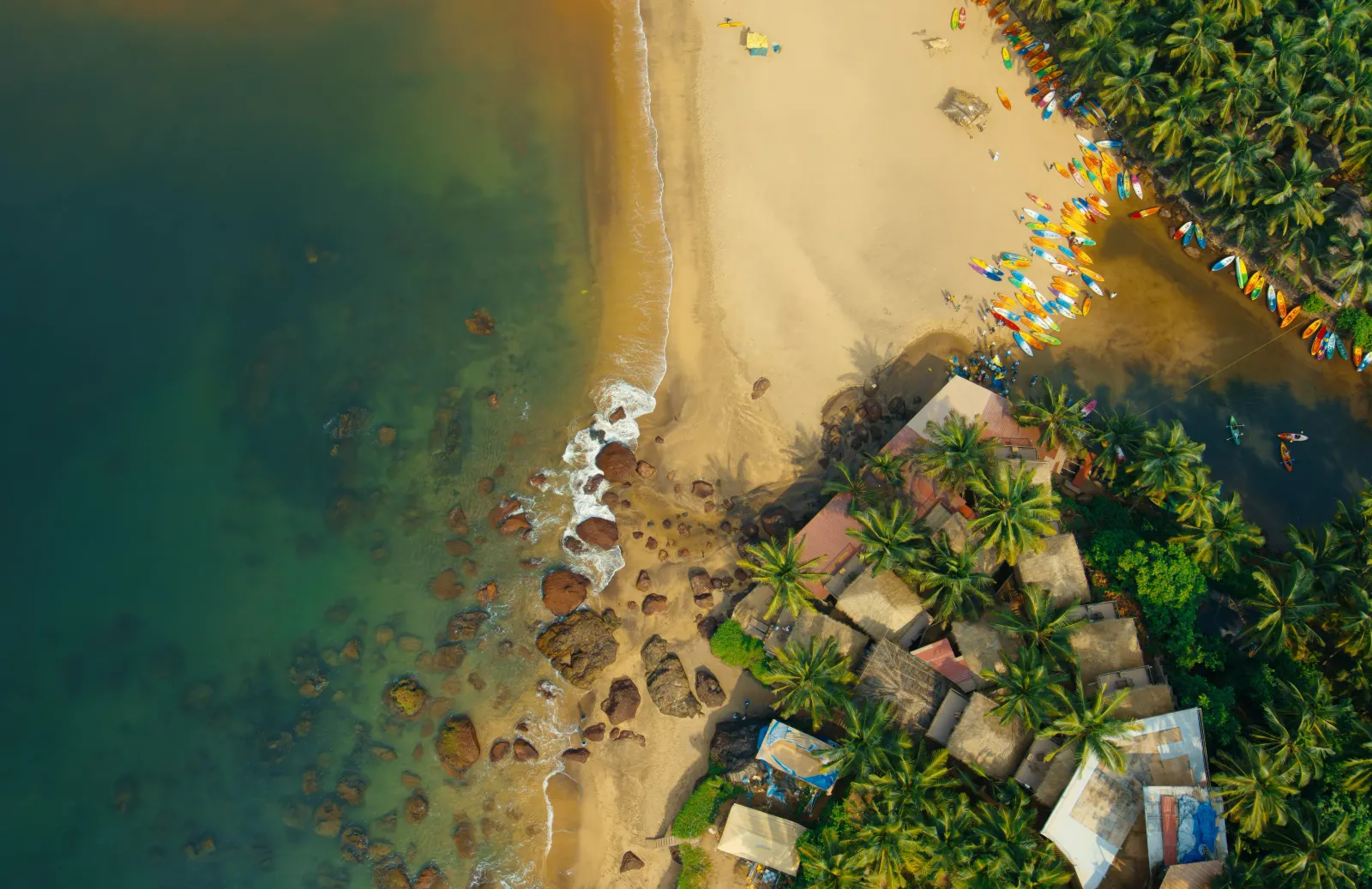


This guide details the state's beaches in geographical order from north to south, providing verified road distances, water sports pricing, lifeguard schedules, historical landmarks, and coastal conservation laws. For planning entire multi-day trips across these shores, consult our Goa travel guide and Goa itinerary guide.
Book with GoaWala
10 options from ₹400 per night — live prices, October 2026.
- North Goa Tour — from ₹400 per person · 9 Hours · North Goa
- South Goa Tour — from ₹400 per person · 9 Hours · South Goa
- Extreme South Goa Tour — from ₹1,500 per person · 10 Hours · South Goa
- Arpora 3-Bedroom Private Pool Villa — from ₹30,000 per night for the whole villa · Arpora, near Baga, North Goa
- Villa Saligao — 4-Bedroom Private Pool Villa — from ₹30,000 per night for the whole villa · Saligao, near Calangute, North Goa
- Vitamin Arpora — 3-Bedroom Pool Villa — from ₹30,000 per night for the whole villa · Arpora, near Baga, North Goa
- Parra House — 5-Bedroom Boutique Villa — from ₹50,000 per night for the whole villa · Parra, North Goa
- Lux Villa — 5-Bedroom Pool Villa near Baga — from ₹60,000 per night for the whole villa · Arpora, near Baga, North Goa
- Casa Arpora — 10-Bedroom Luxury Pool Villa — from ₹67,000 per night for the whole villa · Arpora, near Baga, North Goa
- Arpora House — 8-Bedroom Villa with Pool & Jacuzzi — from ₹80,000 per night for the whole villa · Arpora, near Baga, North Goa
Northern Pernem Beaches: Keri, Morjim, and Mandrem
The northern boundary of Goa begins at the Tiracol River estuary in Pernem taluka. Querim (Keri) Beach sits 35 kilometers north of Panaji and 27 kilometers west (about 45 minutes by road) of Manohar International Airport at Mopa. From the Querim jetty, the River Navigation Department runs a vehicle-and-passenger ferry across the river directly to Fort Tiracol.
South of Keri lie Morjim Beach and Mandrem Beach. Morjim is situated 27 kilometers north of Panaji and 29 kilometers from Manohar International Airport, along the northern bank of the Chapora River estuary. The Goa Forest Department manages Morjim and Mandrem as designated nesting habitats for endangered Olive Ridley sea turtles (Lepidochelys olivacea). Between October and April (and specifically November through April for strict nesting enforcements), the southern spit of Morjim is a demarcated 'No-Take Zone'. Commercial beach shacks, loud music, artificial beachfront lighting, and motorized watercraft are legally prohibited in these zones to protect nesting wildlife.
- Keri (Querim) Beach: Northernmost beach; ferry connects to Fort Tiracol across the river mouth.
- Morjim Beach: Protected Olive Ridley turtle nesting zone along the Chapora River estuary.
- Mandrem Beach: Eco-sensitive stretch with seasonal restrictions on motorized craft and sound systems from October to April.
Bardez Taluka: Vagator, Anjuna, Baga, Calangute, and Candolim
Crossing south across the Chapora River leads into Bardez taluka, the primary commercial beach belt in North Goa. Vagator Beach sits 20 kilometers north of Panaji and 9 kilometers west of Mapusa, located directly beneath the 17th-century Chapora Fort. Chapora Fort is open daily from 9:30 AM to 5:30 PM with free entry.
South of Vagator is Anjuna Beach, where the weekly Anjuna Flea Market operates on the southern beachfront every Wednesday from 9:00 AM to 6:00 PM during the tourist season between October and April. If you plan to stay centrally in this hub, review our guide to luxury private villas in Goa or the organized North Goa sightseeing tour.
The contiguous 4-kilometer stretch comprising Baga, Calangute, Candolim, and Sinquerim contains the highest concentration of tourism infrastructure:
Baga Beach sits 16 kilometers north of Panaji (roughly 35 minutes by car) and 40 kilometers north of Dabolim Airport. Standardized commercial water sports run daily between 9:00 AM and 5:30 PM outside the monsoon. Registered dolphin-watching boat trips operate from Baga River mouth, officially priced between ₹350 and ₹800 per passenger depending on boat capacity.
Calangute Beach lies immediately south of Baga, 15 kilometers northwest of Panaji and 39 kilometers from Dabolim Airport. Water sports here and along Candolim operate exclusively from October through May under Goa Tourism Development Corporation (GTDC) schedules. Standardized baseline rates include ₹1,200 for single beach parasailing (up to two minutes) and ₹1,000 for a five-person banana boat ride.
Candolim and Sinquerim Beaches form the southern end of the Bardez strip, 15 kilometers northwest of Panaji. Sinquerim borders Upper Fort Aguada, constructed by the Portuguese in 1612 and featuring an 1864 four-tiered lighthouse. Upper Fort Aguada is an Archaeological Survey of India (ASI) protected monument open daily from 9:30 AM to 6:00 PM, with entry fees of ₹25 for Indian nationals and ₹300 for foreign visitors (free entry to the upper fort grounds, with parking fees of ₹20 for two-wheelers and ₹50 for cars). The adjoining Fort Aguada Jail Museum charges an entry fee of ₹200 for domestic visitors, ₹400 for foreigners, and ₹100 for Goan residents.
| Beach | Distance from Panaji | Regulated Activity / Landmark | Official Rates / Fees |
|---|---|---|---|
| Vagator | 20 km | Chapora Fort (Open 9:30 AM – 5:30 PM) | Free entry |
| Anjuna | — | Flea Market (Wednesdays, Oct–Apr, 9 AM – 6 PM) | Free access |
| Baga | 16 km | Dolphin-watching boat trips | ₹350 – ₹800 per passenger |
| Calangute | 15 km | Parasailing / Banana Boat (Oct–May) | ₹1,200 parasail / ₹1,000 banana boat |
| Sinquerim | 15 km | Fort Aguada ASI Monument / Jail Museum | Fort: ₹25 Indian, ₹300 Foreign; Museum: ₹200 |
Central Coast: Tiswadi and Mormugao Talukas
South of Bardez, the coastline curves around the mouth of the Mandovi River into Tiswadi taluka. Dona Paula Viewpoint and Jetty sits 7 kilometers southwest of Panaji, overlooking Mormugao Harbour. The renovated promenade is open daily, with a municipal gate entry fee of ₹50 per adult. The nearby Mandovi River in Panaji serves as the departure point for evening cruises; browse options like the sunset cruise in Goa or a dinner cruise in Goa.
Further south across the Zuari River in Mormugao taluka lies Bogmalo Beach. Located 2 kilometers from Bogmalo Beach and 4 kilometers from Dabolim Airport on Bogmalo Road is the Indian Naval Aviation Museum. The museum features 13 outdoor aircraft and is open Tuesday through Sunday from 9:30 AM to 5:30 PM (closed on Mondays). Civilian entry fees are ₹150 for adults and ₹75 for children.
- Dona Paula Jetty: 7 km from Panaji, ₹50 municipal entry fee per adult.
- Bogmalo Beach Area: Features the Indian Naval Aviation Museum 2 km away (closed Mondays; ₹150 adults, ₹75 children).
South Goa Beaches: Canacona Taluka
Canacona taluka in South Goa is known for its wide bays, historical fortifications, and strictly protected wildlife reserves. Travelers can explore this region via self-drive routes or by booking a dedicated South Goa sightseeing tour.
Cabo de Rama Fort and Beach sits on a coastal cliff 28 to 30 kilometers south of Margao and 16 kilometers north of Agonda Beach. Captured by the Portuguese from the Rajas of Soonda in 1763, this 180,000-square-meter fortress is open daily from 9:00 AM to 5:30 PM with no entry fee under the Directorate of Archives and Archaeology.
Agonda Beach, located 36 kilometers south of Margao and 16 kilometers south of Cabo de Rama, is an eco-sensitive Olive Ridley turtle nesting beach protected under Coastal Regulation Zone (CRZ) rules. The Goa Forest Department and Goa Coastal Zone Management Authority strictly ban permanent beachfront concrete constructions, commercial beach shacks within nesting boundaries, open-air speaker systems, and motorized watercraft such as jet skis.
Palolem Beach is positioned 38 kilometers south of Margao Railway Station, 3 kilometers (an 8-minute auto-rickshaw ride) from Canacona Railway Station, and 61 kilometers south of Dabolim Airport. Palolem is enclosed by a semi-circular bay that produces a shallow shorebreak suitable for novice sea swimmers. Commercial operators at Palolem offer motorized boat excursions to nearby Butterfly Beach and Honeymoon Beach.
Galgibaga Beach sits south of the Talpona River, 8 kilometers south of Canacona town and 48 kilometers south of Margao. Monitored year-round by the South Goa Forest Department as a turtle conservation sanctuary, Galgibaga strictly prohibits commercial beach shacks, permanent lighting, loud sound systems, and daytime motorized water sports.
| Beach | Distance from Margao | Protected Status / Key Feature | Permitted Activities |
|---|---|---|---|
| Cabo de Rama | 28–30 km | 1763 Portuguese Fort cliff top | Fort visit (9:00 AM – 5:30 PM, free entry) |
| Agonda | 36 km | Notified Olive Ridley turtle nesting habitat | Silent zone; no jet skis or open-air speakers |
| Palolem | 38 km | Semi-circular bay with shallow shorebreak | Swimming safe zones; boat trips to Butterfly Beach |
| Galgibaga | 48 km | Year-round Forest Dept turtle sanctuary | Walking; shacks, lighting, and jet skis prohibited |
Beach Safety, Lifeguard Monitoring, and Monsoon Closures
State-appointed agency Drishti Marine deploys more than 450 certified lifeguards across 40 beaches throughout Goa daily from 7:00 AM to sunset. Swimming after sunset is strictly prohibited across the entire coastline.
Lifeguards designate swimming zones using international color-coded flags on the sand. Dual red-and-yellow flags mark safe, actively patrolled swimming areas. Solid red flags indicate hazardous conditions, such as sudden drop-offs, submerged rocks, or severe rip currents, where entering the water is completely prohibited by law.
Due to intense monsoon sea surges and high swell, the Goa Department of Tourism and Drishti Marine enforce a blanket ban on sea swimming and coastal water sports across all beaches annually from June 1 through September 30 (extending through October depending on sea conditions). During this period, all beach shacks and commercial watercraft operations remain dismantled.
- Lifeguard hours: 7:00 AM to sunset across 40 patrolled beaches.
- Red-and-yellow flags: Designated safe swimming zones.
- Solid red flags: Dangerous currents or submerged hazards; sea entry prohibited.
- Monsoon closure: Sea swimming and water sports banned from June 1 to September 30 (and through October).
State Beach Regulations and Legal Penalties
Public beach behavior in Goa is governed by the Goa Tourist Places (Protection and Maintenance) Act. To preserve environmental cleanliness and public safety, law enforcement agencies issue spot fines and impound equipment for violations.
Drinking alcohol in non-licensed open public beach areas, breaking glass bottles, cooking food in the open, and unauthorized ticket touting carry spot fines starting from ₹2,000 for individuals and ₹10,000 for groups, reaching up to ₹1,00,000 for severe infractions.
Driving any motorized vehicle—including private four-wheelers, rented scooters, or private ATVs—onto beach sand is completely illegal statewide. Violators face immediate vehicle impoundment and police arrest under the Act, along with penalties ranging between ₹5,000 and ₹1,00,000.
- Drinking alcohol or open cooking on beaches: Fines from ₹2,000 to ₹10,000, up to ₹1,00,000.
- Littering and glass breaking: Penalties up to ₹1,00,000.
- Driving vehicles on beach sands: Illegal statewide; leads to vehicle impoundment, arrest, and fines from ₹5,000 to ₹1,00,000.
Frequently asked questions
Which beaches in Goa have water sports?
Commercial water sports operate primarily along Baga, Calangute, and Candolim beaches in North Goa from October through May between 9:00 AM and 5:30 PM. In contrast, beaches like Morjim, Agonda, and Galgibaga prohibit motorized water sports due to turtle conservation laws.
Can you swim on Goa beaches during the monsoon?
No. The Goa Department of Tourism and Drishti Marine enforce a strict ban on sea swimming and coastal water sports across all beaches from June 1 through September 30 (extending through October) due to heavy swell and dangerous rip currents.
What do the flags on Goa beaches mean?
Dual red-and-yellow flags demarcate safe swimming zones actively monitored by lifeguards between 7:00 AM and sunset. Solid red flags indicate dangerous currents, rocks, or heavy surf where entering the water is legally prohibited.
What is the penalty for driving a car or scooter on the beach in Goa?
Driving any motorized vehicle on the sand is strictly illegal under the Goa Tourist Places Act. Offenses carry spot fines ranging from ₹5,000 up to ₹1,00,000, vehicle impoundment, and police arrest.
Which beaches in Goa are protected turtle nesting sites?
Morjim and Mandrem in Pernem taluka, along with Agonda and Galgibaga in Canacona taluka, are protected Olive Ridley sea turtle habitats managed by the Goa Forest Department. Beach shacks in nesting zones, loud music, and motorized watercraft are banned on these stretches.
What are the official rates for water sports at Calangute and Baga?
Under gazetted GTDC rates, single beach parasailing (up to two minutes) is ₹1,200, a five-person banana boat ride is ₹1,000, and licensed dolphin-watching boat trips at Baga range between ₹350 and ₹800 per passenger.
Sources
- indiatimes.com
- facebook.com
- prudentmedia.in
- itsgoa.com
- oneboard.app
- scribd.com
- heraldgoa.in
- goadiaries.in
- gosahin.com
- oneboard.app
- rome2rio.com
- lamarinebeachcottages.com
- gomantaktimes.com
- trekgo.in
- indiatimes.com
- economictimes.com
- prudentmedia.in
- facebook.com
- traveltriangle.com
- goatravelcompany.com
Last checked 3 October 2026