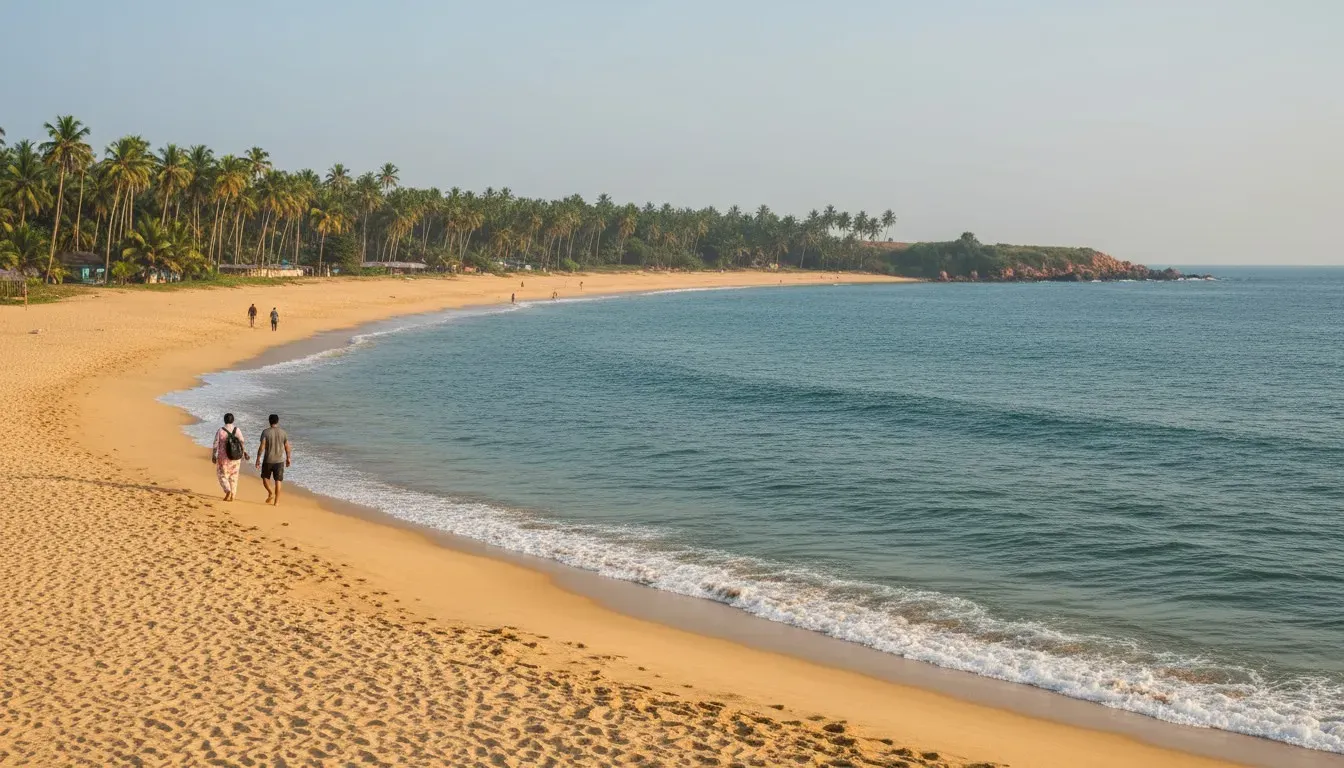


Agonda Beach is a 3-kilometre stretch of open sand in the Canacona taluka of South Goa. Located between a rocky hill to the south and a tidal river mouth to the north, the beach is designated as a protected Olive Ridley sea turtle nesting habitat under Coastal Regulation Zone (CRZ-1A) rules.
Unlike the high-density commercial strips in North Goa, Agonda operates under strict environmental regulations. There are no permanent concrete beachfront hotels, motorized watersports along the surf line are limited, and amplified music is prohibited at night to safeguard coastal wildlife.
This guide covers transport routes, seasonal hut accommodation rates, regulated boat trips, village history, and mandatory conservation rules enforced across the shoreline.
Beach Profile and Swimming Safety
The beach spans roughly 3 kilometres (1.8 miles) along the Arabian Sea. It features a broad sandy expanse that remains open to the public 24 hours daily with no entry fees or permits required.
Unlike neighbouring bays such as Palolem, the shoreline at Agonda has a steep drop-off and heavy shore-break waves ("shore dump"). Inexperienced swimmers and families with small children should exercise caution when entering the water.
State-appointed Drishti Marine lifeguards patrol designated zones daily between 7:30 AM and 6:00 PM (with coverage starting at 7:00 AM at select posts). Swimming after sunset is strictly prohibited, and visitors must never enter the water in zones marked by red flags.
- Shoreline extent: Contiguous 3-kilometre sandy strip bordered by southern rocks and a northern river mouth.
- Lifeguard hours: 7:30 AM to 6:00 PM daily by Drishti Marine.
- Water conditions: Heavy shore-break waves and a steep shelf; red flag zones prohibit entry.
- Access fee: Free pedestrian entry with no permit requirements.
How to Reach Agonda Beach
Agonda village sits in the southern corner of Goa, easily reached by road via National Highway 66. Public buses operated by Kadamba Transport Corporation and private operators run multiple trips each day between the Canacona (Chaudi) bus terminal and the Agonda Church junction, with the last return service leaving Agonda around 6:30 PM.
Prepaid and app-based taxis provide transfers directly to the beach from Goa's two international airports and major railway hubs. For regional route comparisons, read our guide on how to reach Goa.
| Starting Point | Distance | Travel Time | Route Details |
|---|---|---|---|
| Canacona (Chaudi) Railway Station | 9 km | 15–20 minutes | Direct local road north |
| Madgaon (Margao) Railway Station | 37–39 km | 1 hour | Via NH 66 south |
| Dabolim Airport (GOI) | 60–65 km | 1 hour 30 min to 1 hour 45 min | Via NH 66 south through Margao |
| Manohar International Airport, Mopa (GOX) | 105–115 km | 2.5 to 3 hours | North-to-South transit via NH 66 |
| Panaji (State Capital) | 68–70 km | 1 hour 45 min to 2 hours | Southbound via NH 66 |
| Palolem Beach | 9 km | 20 minutes | Coastal connecting road |
Olive Ridley Turtle Conservation and Beach Regulations
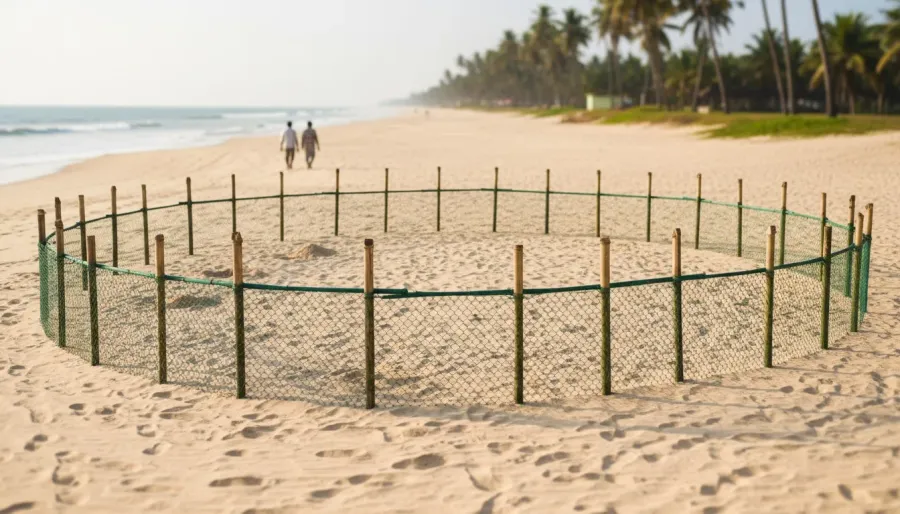
Agonda is one of only four designated Olive Ridley sea turtle (Lepidochelys olivacea) nesting sites in Goa. Protected under Schedule I of India's Wildlife (Protection) Act, 1972, the beach saw a record 181 turtle nests in the 2024 nesting season, up from 68 recorded nests in 2023.
The Goa Forest Department's South Goa Marine Range operates a fenced Turtle Rehabilitation Centre (hatchery) directly on the sand. Night patrol teams identify nests along the beach and transfer eggs into enclosed pits to protect them from predators throughout their 45-to-50-day incubation period before hatchlings are released into the Arabian Sea.
To preserve the nesting habitat, local authorities enforce strict rules under coastal and wildlife protection directives. Commercial beach shacks must remove all deck beds, tables, and umbrellas from the open sand after sunset and are prohibited from directing high-intensity floodlights toward the water.
- Nesting season: Annual cycle runs from November through April.
- Night noise limits: Amplified music and loud outdoor beach parties are strictly prohibited after 10:00 PM; shack policies restrict loud music between 6:00 PM and 8:00 PM.
- Lighting and fire: Flash photography, high-intensity lights, and beach bonfires are barred in turtle conservation areas at night.
- Wildlife interaction: Touching sea turtles or approaching marked hatchery enclosures is illegal under the Wildlife Protection Act.
- Vehicle ban: Driving motorized two-wheelers or four-wheelers on the sand is illegal under Forest Department rules.
- Civic penalties: Spot fines ranging from ₹5,000 to ₹1,00,000 apply for driving on the beach, open-air cooking, littering, and drinking alcohol outside licensed premises.
Boating, Kayaking, and Watersports
Because Agonda is a protected turtle breeding ground, heavy motorized beach sports along the surf zone are restricted. Regulated daytime boat excursions depart directly from the beach between 6:30 AM and 6:30 PM outside the monsoon season, subject to weather and sea conditions.
Local boat operators, including Gadu Boat Rides, run private 90-minute boat trips to view coastal dolphins and visit Butterfly Beach. These private excursions cost approximately ₹3,500 per boat for up to 6 passengers (2024–2026 rates). If you want to explore marine safaris across Goa, check our guide on dolphin spotting trips in Goa.
Watersport operators along the beach also provide rental kayaks. Typical rates are ₹300 per hour for a single kayak and ₹600 per hour for a double kayak. To plan paddling outings elsewhere in the state, see our details on kayaking in Goa. During the southwest monsoon (June to September), all boating trips, watersports, and temporary shoreline installations are completely suspended.
Beach Huts and Seasonal Accommodation Costs
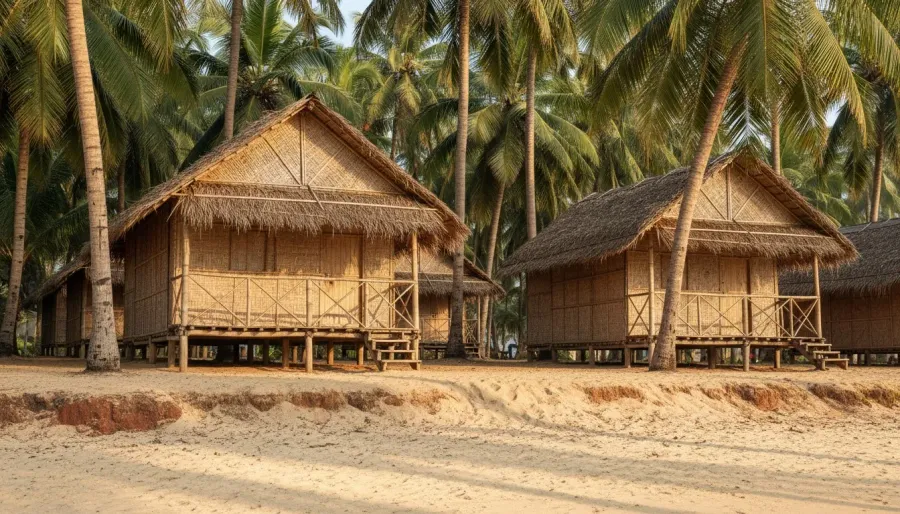
Due to Coastal Regulation Zone (CRZ) rules, all temporary wooden beach shacks and eco-cottages on Agonda Beach are dismantled before the monsoon begins in June and rebuilt each October. Shacks operate daily between October and May, serving food and drinks typically from 8:00 AM to 11:00 PM.
Accommodation directly behind and along the sand consists primarily of seasonal huts. For traveller budgeting during the 2025–2026 season:
- Standard non-AC beach huts range from ₹1,200 to ₹2,500 per night. - Sea-facing air-conditioned cottages cost between ₹3,000 and ₹6,000 per night, varying by month and peak holiday availability.
For travellers seeking fixed stays across the region, browse our overview of where to stay in South Goa.
Village Heritage and Nearby Attractions
Agonda village holds notable regional heritage. Along the main village road behind the beach stands St. Anne's Church (Santa Ana Igreja). Originally established as a chapel under Canacona parish before 1859, it became an independent parish on December 27, 1888, with reconstruction taking place in 1951 and 2001. Agonda is also the founding site of the Society of the Missionaries of Saint Francis Xavier (the Society of Pilar), formed here on September 26, 1887, by Fr. Jose Mariano Bento Martins before the order moved its motherhouse to Pilar in 1890. The parish feast of St. Anne's is celebrated on the first Sunday of May.
Several scenic locations in Canacona taluka are accessible by road from Agonda:
- Cola (Khola) Beach: Located 4 to 5 km north, known for its natural freshwater lagoon running parallel to the sea. - Cabo de Rama Fort: Situated 14 km north (about a 30-minute drive). Managed by the Directorate of Archives and Archaeology, entry is free and gates open daily from 9:00 AM to 5:30 PM. - Palolem Beach: Located 9 km south (roughly a 20-minute drive), featuring calmer swimming waters, restaurants, and boat trips. Read more in our guide to Goa beaches. - Butterfly Beach: A cove 12 km south by road/trail, or reachable in 15 to 20 minutes via motorboat from Agonda. - Galgibaga Beach: Situated 16 km south, serving as another protected Olive Ridley turtle nesting beach managed by the Goa Forest Department. - Cotigao Wildlife Sanctuary: Located 32 km southeast in Canacona taluka, open daily from 7:00 AM to 5:30 PM with an adult entry fee of ₹20 to ₹50.
For travellers looking to combine multiple sights across the region in an organised day excursion, consider booking the Extreme South Goa Tour.
Book with GoaWala
6 options from ₹350 per person — live prices, October 2026.
- Thunder World Goa — from ₹350 per person · 2 Hours · North Goa
- Kayaking in Goa — from ₹400 per person · 30 Minutes · North Goa
- North Goa Tour — from ₹400 per person · 9 Hours · North Goa
- Snow Park Goa — from ₹400 per person · 2 Hours · North Goa
- South Goa Tour — from ₹400 per person · 9 Hours · South Goa
- Extreme South Goa Tour — from ₹1,500 per person · 10 Hours · South Goa
Frequently asked questions
Is swimming safe at Agonda Beach?
Swimming requires caution due to a steep shoreline drop-off and heavy shore dump waves. Lifeguards monitor marked swimming zones daily from 7:30 AM to 6:00 PM, and swimming is prohibited after sunset or in red-flag zones.
Can you see turtles at Agonda Beach?
Olive Ridley sea turtles nest and hatch along Agonda Beach between November and April. The Goa Forest Department maintains an enclosed hatchery on the sand; touching turtles, using flashlights, or disturbing marked nesting pits is prohibited by law.
What does a boat ride from Agonda Beach cost?
Private 90-minute boat trips to view dolphins and visit Butterfly Beach cost approximately ₹3,500 per boat for up to 6 passengers outside the monsoon season.
How much do beach huts cost at Agonda?
For the 2025–2026 season, basic non-AC beach huts range from ₹1,200 to ₹2,500 per night, while sea-facing air-conditioned cottages range from ₹3,000 to ₹6,000 per night.
Are parties and loud music allowed on Agonda Beach?
No. Amplified music and outdoor parties are banned after 10:00 PM under national noise rules and turtle conservation directives, with shack music restricted after early evening.
How do I travel between Madgaon Station and Agonda?
Madgaon (Margao) Railway Station is approximately 37 to 39 kilometres north of Agonda Beach, taking roughly one hour by road via National Highway 66.
Sources
- wordpress.com
- toptotrip.in
- goadiaries.in
- webindia123.com
- roundglasssustain.com
- thegoavilla.com
- rove.me
- goa.gov.in
- facebook.com
- palolemgoavibes.com
- gomantaktimes.com
- myticketstoindia.com
- agondagoa.com
- facebook.com
- rome2rio.com
- trawell.in
- itsgoa.com
- heraldgoa.in
- thegoan.net
- indiatimes.com
Last checked 9 October 2026