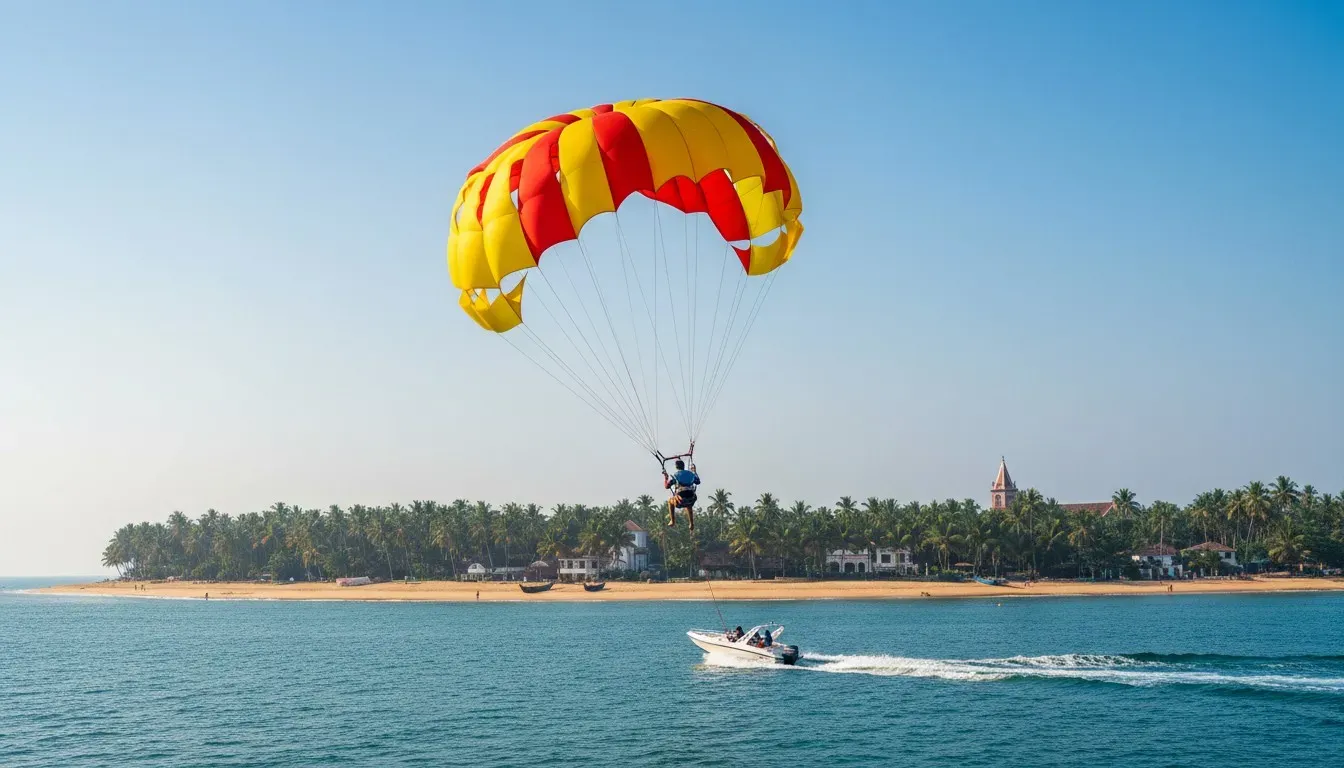


All commercial speedboats, winches, and launch operators are regulated under state maritime safety directives enforced by the Captain of Ports, the Directorate of Tourism, and the National Institute of Water Sports (NIWS). Operations remain suspended throughout the annual southwest monsoon due to rough sea states.
This guide covers verified flight pricing, designated launch corridors across North and South Goa, participant weight and age restrictions, and official maritime operating rules.
Parasailing Costs and Package Options in Goa
Parasailing rates in Goa vary depending on whether you choose a standard dry flight, add a sea dip, or book on a North Goa or South Goa beach. Standard solo flights without a dip range between ₹800 and ₹1,200 on North Goa shores, rising to ₹1,300 at select counters. In South Goa locations such as Mobor Beach, single flights generally cost between ₹1,500 and ₹1,800.
Participants can choose an optional sea dip, where the boat captain drops throttle to submerge the flyer's lower body into the water before powering back up into the air. Adding this option brings the rate to between ₹1,199 and ₹1,800 per flyer. Visitors looking for a complete water sports in Goa outing can purchase multi-activity beach combos at authorized ticketing counters. These packages combine parasailing with a jet ski run, banana boat ride, and bumper boat ride for ₹1,500 to ₹2,200 per adult.
| Activity Option | Price Range (Per Person) | Flight Characteristics |
|---|---|---|
| Standard Solo Flight (North Goa) | ₹800 – ₹1,300 | Dry takeoff and landing; 2 to 3 minutes in the air |
| Flight with Sea Dip (North Goa) | ₹1,199 – ₹1,500 | Controlled mid-flight waist-deep dip into the sea |
| Standard Solo Flight (South Goa / Mobor) | ₹1,500 – ₹1,800 | Winch-boat departure near the Sal River mouth |
| Watersports Combo Package | ₹1,500 – ₹2,200 | Includes parasailing, jet ski, banana boat, and bumper ride |
Top Beach Launch Locations in North and South Goa
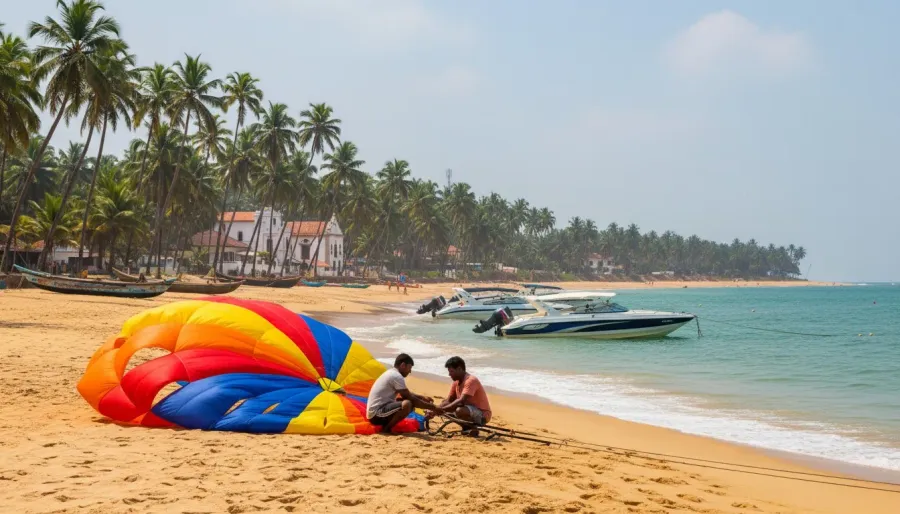
Commercial parasailing in Goa is concentrated on designated beaches that maintain marked water-sports corridors established by the Department of Tourism. Each beach provides dedicated staging areas on the sand and authorized ticketing setups.
To plan travel times between launch sites, consult our guide on how to reach Goa and transit between coastal areas, or explore full beach profiles in our Goa beach directory.
- Calangute Beach (Bardez): Situated 16 km west of Panaji (a 35-minute drive), Calangute is Goa's primary parasailing hub with dedicated watersports launch corridors demarcated by the Department of Tourism.
- Baga Beach (Bardez): Located 2 km north of Calangute and 17 km from Panaji, Baga offers daily flights alongside government pay-and-park areas and public changing rooms.
- Candolim Beach (Bardez): Positioned 13 km northwest of Panaji (a 30-minute drive) and 3 km north of Sinquerim, Candolim provides aerial perspectives of the Aguada headland.
- Anjuna and Vagator Beaches (Bardez): Located approximately 21 km from Panaji, offering parasail departures against the backdrop of the red laterite headlands of Chapora.
- Colva Beach (Salcete): Located 8 km west of Margao railway station (a 20-minute drive), serving as South Goa's primary beach watersports center.
- Mobor Beach (Cavelossim, Salcete): Located 17 km south of Margao, offering both open-sea and estuary-adjacent winch-boat parasailing near the mouth of the Sal River.
- Dona Paula Jetty (Tiswadi): Situated 7 km south of Panaji, providing seasonal flights over the Zuari River estuary with nearby municipal changing facilities and pay-and-park spaces.
- Grand Island (Ilha Grande, Mormugao): Winch-boat parasailing tours depart via registered vessels from Sinquerim Jetty in Bardez, running daily between 8:30 AM and 3:30 PM from October to May.
How Parasailing Operates: Winch Boats vs Beach Liftoffs
Parasailing in Goa uses two primary operational systems: open beach liftoffs and offshore hydraulic winch boats. In beach liftoffs, a ground crew manages the towline directly from the sand, lifting the flyer into the air as the speedboat pulls away from shore.
Most modern commercial runs utilize offshore hydraulic winch boats. Under this method, participants board a transfer boat on the beach that ferries them out to a specialized motorboat anchored in deeper water. Flyers are secured into a safety harness attached to a parasail canopy, which is launched and retrieved mechanically directly from a flight platform on the boat's stern deck.
A standard flight uses a tow rope measuring between 200 and 350 feet in length, elevating the participant to altitudes between 200 and 320 feet (60 to 100 metres) above sea level. Active flight time in the air lasts between 2 and 5 minutes (standard commercial runs average 2 to 3 minutes). The complete speedboat outing, including passenger transfers and rotation, takes approximately 15 to 30 minutes.
Weight Limits, Age Rules, and Health Eligibility
State maritime regulations and commercial equipment specifications enforce strict weight and health limits for all parasailing participants to maintain canopy stability.
Solo flyers must weigh a minimum of 45 to 50 kg to maintain ballast. Participants weighing less than 45 kg are required to fly tandem alongside another passenger or an instructor. The standard maximum weight limit for a solo flyer is capped between 90 kg and 110 kg depending on wind conditions.
Tandem flights allow two flyers to share a canopy under a shared bar, with combined weight restrictions set between 140 kg and 150 kg (with select systems accommodating up to 190 kg based on operator winch specifications).
Participants must be at least 10 to 12 years of age to fly. State watersports regulations require flyers to sign medical declarations; individuals with severe cardiac conditions, respiratory illness, spine issues, or pregnancies are strictly prohibited from flying.
Operating Season, Daily Timings, and Weather Regulations
Commercial parasailing operates exclusively during the fair-weather season from October through May. The core window for optimal flights occurs between November and February, when sea conditions are calm and coastal wind speeds remain steady. If you are scheduling your holiday around water activities, read our overview of the best time to visit Goa.
Under safety directives from the Captain of Ports and Drishti Marine, parasailing is prohibited state-wide during the southwest monsoon from June 1 to mid-September due to rough sea conditions and heavy swells. Drishti Marine lifeguards raise red no-entry flags on beaches during this period.
Daily watersports sessions run between 8:30 AM or 9:00 AM and 5:30 PM or 6:30 PM (or sunset, whichever occurs earlier). All parasailing operations must halt immediately whenever sea-level wind speeds exceed 15 miles per hour (approximately 24 km/h). Boat operators are legally required to carry a handheld wind gauge or maintain a visible windsock to monitor wind velocity continuously.
Safety Standards, Operator Licensing, and Equipment Rules
Commercial watersports in Goa are regulated under the Goa Tourist Places (Protection and Maintenance) (Boat Rides / Parasailing and Watersports activities) Rules, 2005. To eliminate unregulated touting and unauthorized price variations, the Goa Tourism Development Corporation (GTDC) maintains official ticketing kiosks and an automated queue management system on major beaches.
Every commercial speedboat, winch boat, and parasail unit must register with the Directorate of Tourism under the Goa Registration of Tourist Trade Act and obtain an annual vessel seaworthiness permit from the Captain of Ports. Operators are also legally required to maintain third-party passenger liability insurance.
Vessel captains must hold a PBH-4 (Level 3) powerboat handling certification issued by the National Institute of Water Sports (NIWS) in Caranzalem, Panaji. Speedboats towing parasails must have a minimum motor power of 90 horsepower, complete with remote-control steering and a designated tow-point. Each tow boat must carry a licensed driver and a designated lookout spotter whose sole duty is to track the airborne flyer, nearby vessels, and swimmers. All participants and boat passengers must wear an approved life jacket and a light helmet.
Book with GoaWala
3 options from ₹1,000 per person — live prices, October 2026.
- Monsoon Adventure — from ₹1,000 per person · 4 Hours 30 Minutes · Panaji (Central Goa)
- Bungee Jumping Goa — from ₹2,800 per person · 1 Hour · North Goa
- Jumpin Heights Goa — from ₹4,500 per person · 1 Hour · North Goa
Frequently asked questions
How much does parasailing cost in Goa?
A standard solo parasailing flight in North Goa costs between ₹800 and ₹1,300 per person without a sea dip. Adding an optional mid-flight sea dip brings the price to ₹1,199 to ₹1,800, while South Goa locations like Mobor charge ₹1,500 to ₹1,800.
How long do you stay in the air during parasailing in Goa?
Actual flight time in the air ranges from 2 to 5 minutes, with standard commercial runs averaging 2 to 3 minutes. The total speedboat trip for passenger transfers and canopy winch deployment takes roughly 15 to 30 minutes.
What is the weight limit for parasailing in Goa?
Solo flyers must weigh at least 45 to 50 kg, with maximum individual limits set between 90 kg and 110 kg. Participants under 45 kg fly tandem, where the total combined weight is generally capped between 140 kg and 150 kg (up to 190 kg on select winch boats).
Can non-swimmers go parasailing in Goa?
Yes. Non-swimmers can safely participate because state maritime rules mandate that every flyer wear an approved life jacket and a light helmet for the entire duration of the boat ride and flight.
When is parasailing closed in Goa?
Parasailing is strictly banned across all Goa beaches during the southwest monsoon from June 1 through mid-September under orders from the Captain of Ports and Drishti Marine due to rough seas.
What happens if wind speeds pick up during the day?
Under Goa maritime regulations, operators must monitor wind speeds using a handheld wind gauge or windsock and immediately halt all flights if wind velocity exceeds 15 mph (24 km/h) or if lifeguards raise red warning flags.
Sources
- indiatimes.com
- caravelabeachresortgoa.com
- tripnetra.com
- holidify.com
- thrillophilia.com
- makemytrip.com
- facebook.com
- goatravelcompany.com
- goa.gov.in
- indiatimes.com
- offbeatpeak.com
- trip.com
- goasathi.com
- oneboard.app
- heraldgoa.in
- cruisesingoa.com
- goaholidayhomes.com
- goatourspackage.com
- klook.com
- testbook.com
Last checked 5 October 2026