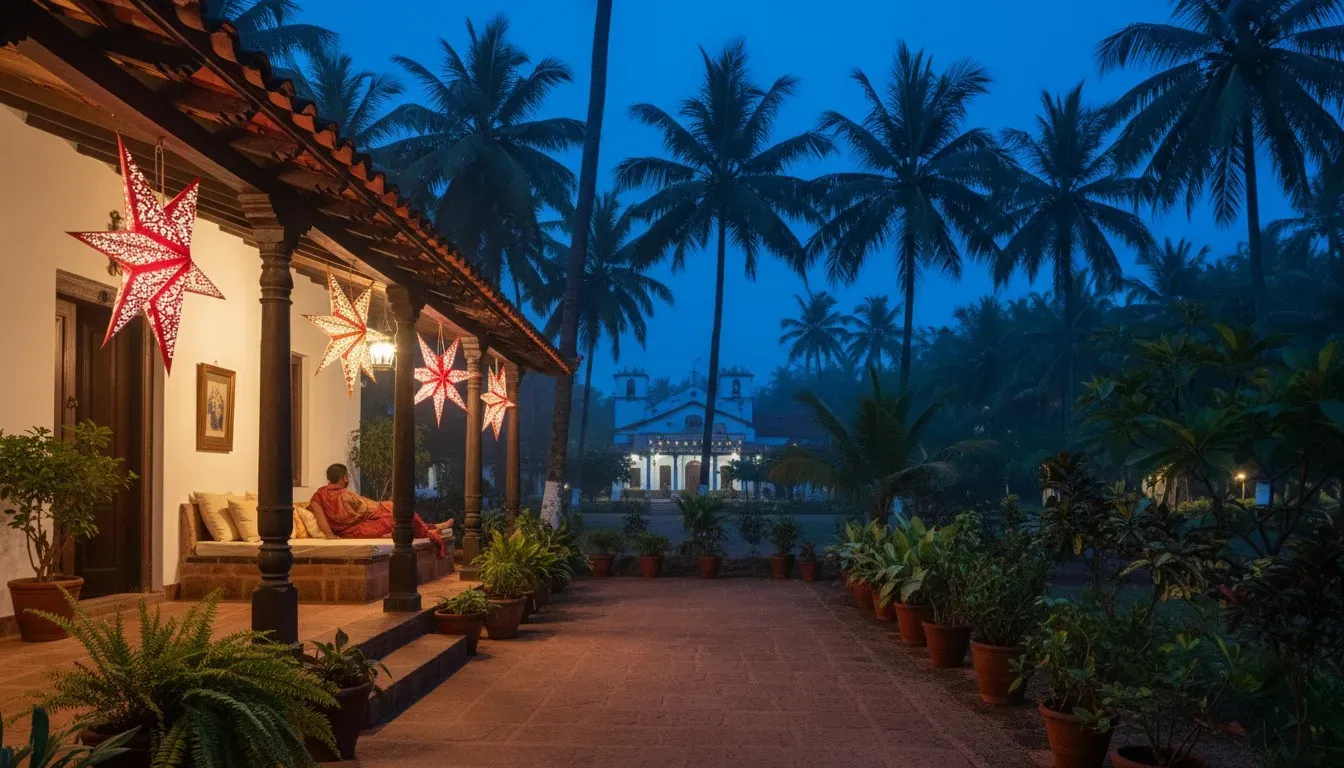


Across the state, villages and towns light up with traditional paper star lanterns (*estrelas*) hung outside homes and verandas starting with the first Sunday of Advent. Christmas Eve centers around community carol singing and Midnight Mass (*Missa do Galo*), followed by the exchange of homemade Goan confectionery known as *kuswar*.
This guide outlines Midnight Mass schedules, church dress codes, notable nativity crib displays, traditional food, local noise and beach regulations, and transport options for planning your Christmas visit.
The Festive Calendar and December Weather
The Christmas season officially runs from December 20 to January 6 across Goa. It concludes on January 6 with the Three Kings Feast at the Chapel of Our Lady of Remedies on Cuelim Hill in Cansaulim, located 16 km north of Margao.
December offers some of the clearest weather of the year in coastal Goa. Daytime temperatures reach highs between 31°C and 33°C, while evenings cool down to lows between 20°C and 22°C. Total rainfall during December is generally below 15 mm, making open-air gatherings and evening travel comfortable.
Paper star lanterns are hung outside verandas, residential windows, and church squares across both North and South Goa from late November or early December through early January.
Midnight Mass (Missa do Galo) and Church Timings
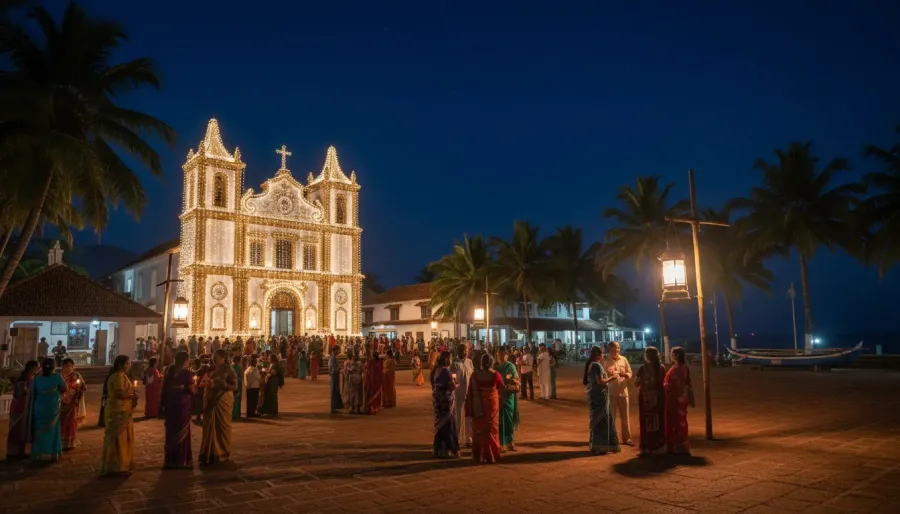
Catholic religious traditions in Goa trace back to 1510, when Portuguese explorer Afonso de Albuquerque conquered the region, establishing the religious and culinary practices seen today. Midnight Mass in Goa is historically termed *Missa do Galo* ("Mass of the Rooster"), named after the ancient Latin tradition commemorating the crowing rooster on the night of the Nativity.
On Christmas Eve (December 24), parish churches across Goa schedule carol singing starting between 11:00 PM and 11:30 PM, followed by the Eucharistic celebration starting at 11:30 PM or 12:00 AM. Services in major parishes are conducted in both Konkani and English.
Entry to all operational Catholic parish churches, the Basilica of Bom Jesus, and Sé Cathedral is completely free of charge. Visitors planning a broader heritage trip can check our places to visit in Goa guide or book a dedicated South Goa tour.
| Church Name | Location | Regular Visiting Hours | Christmas Eve Service |
|---|---|---|---|
| Basilica of Bom Jesus | Old Goa (NH748) | Mon–Sat: 9:00 AM – 5:00 PM, Sun: 11:00 AM – 5:00 PM | Vigil & Mass from 11:30 PM |
| Sé Cathedral | Old Goa | Daily: 7:30 AM – 6:00 PM | Courtyard Mass from 11:30 PM |
| Our Lady of the Immaculate Conception | Panaji Church Square | Daily: 9:00 AM – 12:30 PM, 3:30 PM – 7:30 PM | Carols 11:00 PM, Mass at Midnight |
| Mae de Deus Church | Saligao, Bardez | Daily: 9:00 AM – 12:30 PM, 3:00 PM – 5:00 PM | Evening mass; illuminated facade |
Church Etiquette and Visitor Guidelines
Active Catholic churches in Goa strictly enforce modest dress requirements. Visitors entering the Basilica of Bom Jesus, Sé Cathedral, or local village parishes must wear attire covering their shoulders and knees. Tank tops, sleeveless shirts, beachwear, and shorts above the knee are not permitted past the doors.
Inside the sanctum areas, personal photography and videography during religious services and masses are prohibited. When visiting historic quarters like Fontainhas in Panaji, commercial filming and photography require permits from the Entertainment Society of Goa (ESG), and visitors must refrain from blocking narrow streets or stepping onto private verandas.
- Cover shoulders and knees prior to entering any church compound.
- Turn off camera flashes and refrain from recording during liturgical ceremonies.
- Keep voice levels down inside heritage churches, museums, and prayer areas.
- Arrive by 10:30 PM on December 24 if you plan to attend Midnight Mass inside the church seating area.
Village Nativity Cribs and Competitions
Nativity scenes (*presepios*) are an essential part of Christmas in Goa. Starting from December 26 to December 31, the Directorate of Art and Culture, Government of Goa, conducts an annual State Level Crib Competition. The contest features cash prizes up to ₹40,000 for institutions and parishes, and up to ₹25,000 for individual households.
Several parishes are renowned for elaborate, community-built outdoor cribs during late December. St. Alex Church in Curtorim, located 10 km east of Margao in Salcete taluka, constructs large cribs erected directly over the village lake. Other prominent community displays can be found at Our Lady of Snows Church in Raia and Mae de Deus Church in Saligao. Exploring these villages gives a direct look at local Goan community traditions.
Traditional Christmas Sweets: The Goan Kuswar Platter
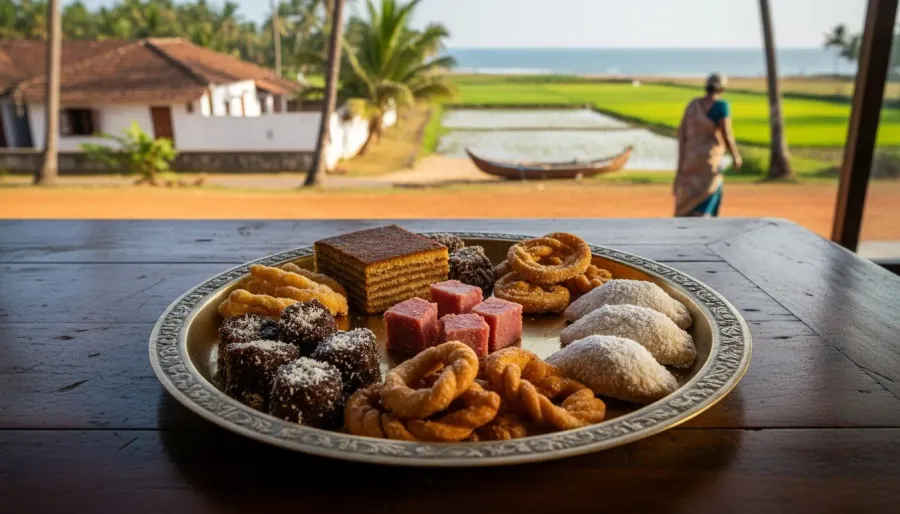
On Christmas Eve, Goan families assemble and exchange *kuswar* (also known by the Portuguese term *consoada*), a platter filled with homemade confections. The platter typically features bebinca, dodol, kulkuls (deep-fried curls), perad (guava cheese), and neureos (sweet crescent pastries).
Bebinca is an Indo-Portuguese layered dessert prepared using coconut milk, egg yolks, sugar, ghee, and flour, baked patiently into 7 to 16 individual layers. Dodol is a dark, chewy confection prepared by stirring coconut milk, rice flour, and locally harvested black coconut jaggery (*madachem god*) over low heat for several hours until glossy.
To sample heritage bakes, visit Confeitaria 31 de Janeiro on Rua 31 de Janeiro in the Fontainhas Latin Quarter of Panaji. Founded in 1930, this bakery operates Monday through Saturday from 8:00 AM to 8:00 PM (closed Sundays), preparing traditional Goan sweets and cakes in wood-fired ovens. For broader regional dining ideas, check our Goa food and nightlife guide.
Evening Celebrations and River Cruises
Aside from religious observances, the holiday season brings lively evening celebrations along the Mandovi River in Panaji. Goa Tourism Development Corporation (GTDC) and licensed private operators run evening sightseeing cruises from the Santa Monica Jetty on Old Panaji Road. Standard 1-hour sunset cruise tickets are priced between ₹500 and ₹800 per person.
Travellers looking to spend Christmas evening on the water can book dedicated outings such as the Princesa Sunset Cruise (₹450 per person) or the Paradise Dinner Cruise (₹1,000 per person), both departing from central Panaji. For larger groups celebrating together, private yachts like the AQUILA Yacht (₹14,000 per charter for up to 10 guests) operate from Britona along the Mandovi. Explore our complete guide to dinner cruises in Goa for more details.
Local Regulations, Sound Limits, and Beach Rules
Goa enforces clear public safety and environmental laws that apply throughout the holiday week:
Sound curfews: Under the Noise Pollution (Regulation and Control) Rules, outdoor music must stop at 10:00 PM. The Department of Environment grants relaxations until 12:00 midnight on notified dates including December 24 and December 25 on a permitted case-by-case basis.
Alcohol and beach laws: Under the Goa Tourist Places (Protection and Maintenance) Act, consuming alcohol on public beaches and in unlicensed open public spaces is illegal, carrying police fines between ₹5,000 and ₹1,00,000. Cooking in the open, littering, or breaking glass bottles on beaches attracts minimum fines of ₹5,000 and possible prosecution under Section 223 of the Bharatiya Nyaya Sanhita. Driving two-wheelers or four-wheelers on any beach is prohibited, risking vehicle impoundment and fines from ₹5,000 to ₹50,000.
Sea safety: Drishti Marine lifeguards monitor more than 40 coastal stretches daily from 7:00 AM until sunset. Swimming after sunset is strictly prohibited. Red-and-yellow flags mark designated safe swimming zones, while solid red flags denote rip currents where entering the sea is banned. For emergencies across any taluka, call 112 for police, ambulance, fire, and rescue assistance. Read more safety essentials in our Goa travel tips guide.
Transit and Getting Around at Christmas
Reaching Goa's churches and festive hubs during peak week requires planning transit ahead. Kadamba Transport Corporation Limited (KTCL) operates scheduled air-conditioned electric buses connecting both airports to key towns.
From Manohar International Airport (MOPA/GOX) in Pernem (35 km north of Panaji), KTCL express shuttles run to Mapusa for ₹150 per seat and Calangute for ₹200 per seat. From Dabolim Airport (GOI) in South Goa (26 km south of Panaji), direct KTCL air-conditioned shuttle buses travel to the Panaji Central Bus Stand for ₹150 per passenger.
For local exploration around Old Goa and the backwaters, the River Navigation Department operates commuter ferries between Ribandar and Divar Island daily from 6:00 AM to 2:00 AM; pedestrian passage is free, while four-wheelers are charged ₹10 to ₹30 per trip. Find complete route schedules in our getting around Goa guide.
Book with GoaWala
23 options from ₹400 per person — live prices, October 2026.
- Calma Sundowner Cruise — from ₹400 per person · 1 Hour 30 Minutes · Panaji (Central Goa)
- Capital Sundowner Cruise — from ₹400 per person · 1 Hour 30 Minutes · Panaji (Central Goa)
- North Goa Tour — from ₹400 per person · 9 Hours · North Goa
- Paradise Sunset Cruise — from ₹400 per person · 1 Hour 30 Minutes · Panaji (Central Goa)
- South Goa Tour — from ₹400 per person · 9 Hours · South Goa
- Vihaan Sunset Cruise — from ₹400 per person · 1 Hour 30 Minutes · Panaji (Central Goa)
- Princesa Sunset Cruise — from ₹450 per person · 2 Hours · Panaji (Central Goa)
- Coral Dinner Cruise — from ₹850 per person · 3 Hours · Panaji (Central Goa)
Frequently asked questions
When does Midnight Mass start in Goa on Christmas Eve?
Parish churches across Goa begin Christmas Eve services with carol singing between 11:00 PM and 11:30 PM on December 24, followed immediately by the Eucharistic Midnight Mass celebrated at 11:30 PM or 12:00 AM.
What is the dress code for attending Christmas services in Goa?
Visitors must wear clothing that covers both shoulders and knees. Sleeveless tops, tank tops, beach shorts, and revealing swimwear are strictly barred at church entry gates.
What is included in the traditional Goan Christmas kuswar platter?
Kuswar is a collection of festive sweets exchanged between neighbours, including bebinca, dodol (black jaggery sweet), kulkuls, perad (guava cheese), and neureos.
Are loud beach parties allowed after midnight on Christmas in Goa?
No. The state's standard outdoor loudspeaker curfew is 10:00 PM, with official relaxations extending only until 12:00 midnight on Christmas Eve and Christmas Day on a case-by-case permitted basis.
Is drinking alcohol allowed on beaches during Christmas in Goa?
Drinking alcohol on public beaches and in unlicensed public spaces is prohibited under the Goa Tourist Places Act, with fines ranging from ₹5,000 to ₹1,00,000.
What is the weather like in Goa around Christmas?
December features daytime highs of 31°C to 33°C, comfortable night lows of 20°C to 22°C, and minimal rainfall under 15 mm across the month.
Where can you see community nativity cribs during Christmas week?
Notable community cribs are built at St. Alex Church in Curtorim (set up over the lake), Our Lady of Snows Church in Raia, and Mae de Deus Church in Saligao, alongside household cribs participating in the State Level Crib Competition from December 26 to December 31.
Sources
- goa-tourism.org.in
- thrillophilia.com
- goa-tourism.com
- miroshotels.com
- gomantaktimes.com
- happyfares.in
- goa-tourism.com
- churchtimings.com
- holidify.com
- trawell.in
- goa-tourism.com
- tourmyindia.com
- rome2rio.com
- facebook.com
- pavancab.com
- testbook.com
- tui.co.uk
- holiday-weather.com
- thomascook.com
- goanewshub.com
Last checked 5 October 2026