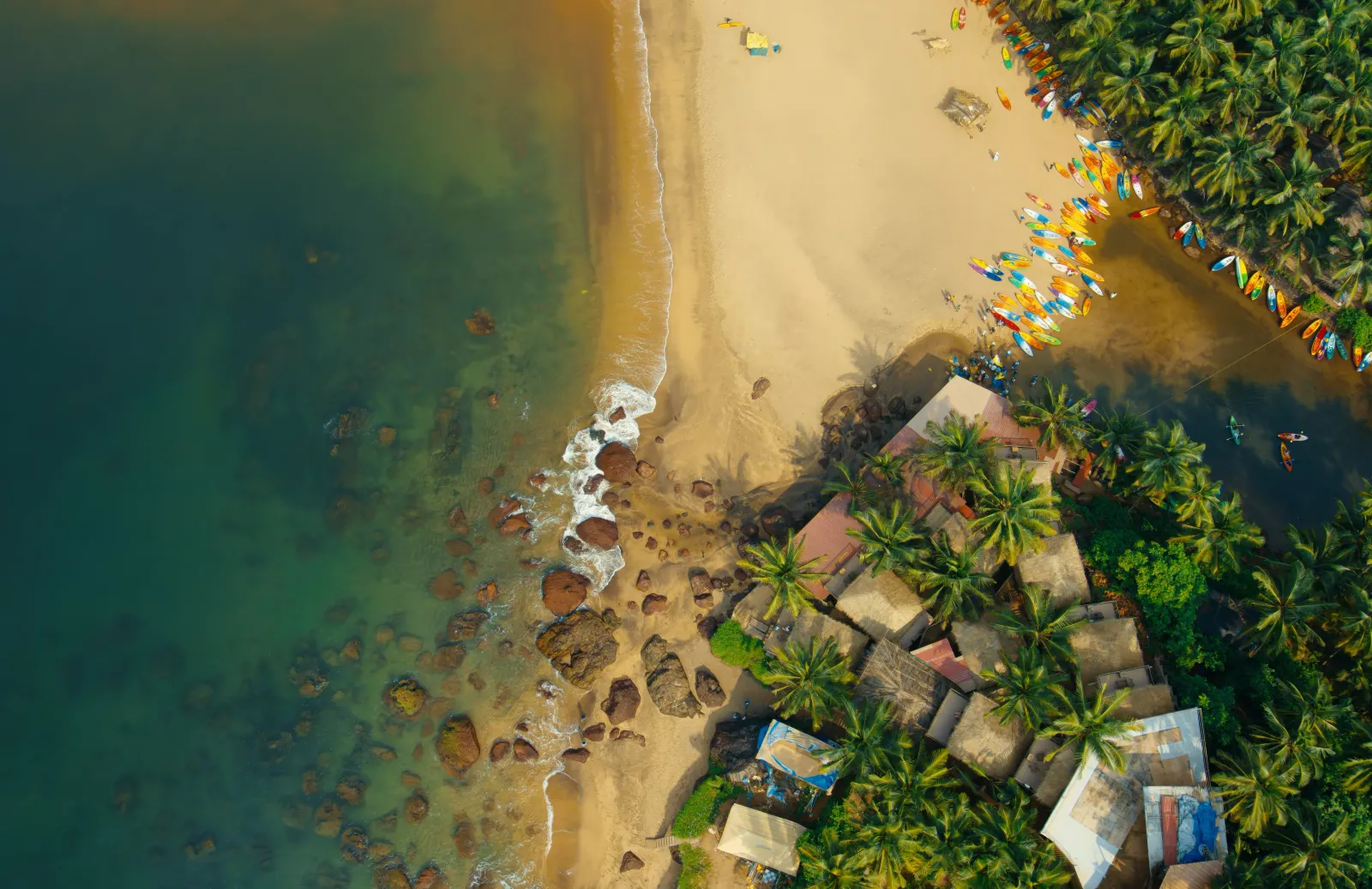


Narkasur is Goa's distinctive Diwali celebration commemorating the victory of Lord Krishna and Satyabhama over the demon king Narakasura. Taking place annually on Narak Chaturdashi—the eve and dawn of Diwali between mid-October and mid-November—the festival features demon effigies built by neighbourhood youth groups, paraded through town centres and ritually burned at dawn before sunrise.
All public roadside viewings, village processions, and open-ground effigy competitions hosted by municipal councils across Goa are completely free of charge to spectators.
This guide covers the full festival timeline, top viewing spots across North and South Goa, crowd and safety regulations, and the traditional Goan morning rituals that immediately follow the burnings.
The Narkasur Tradition: Origins and Effigy Making
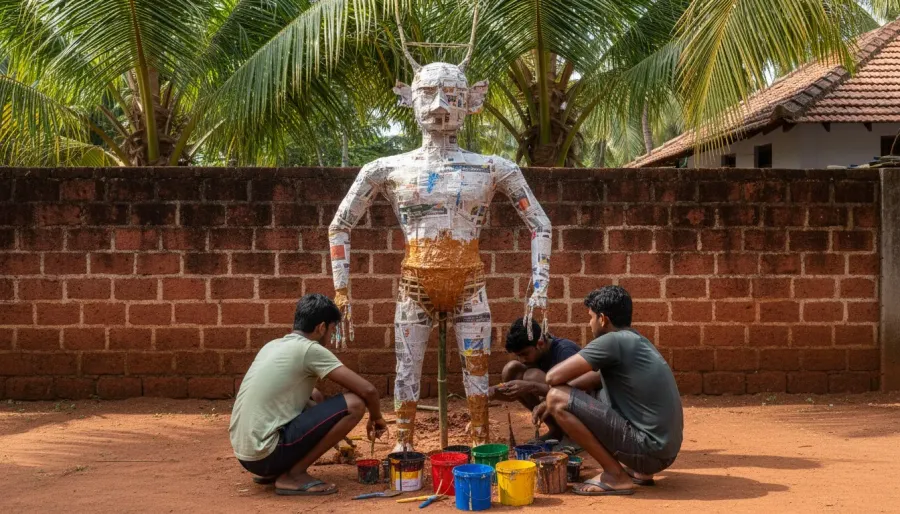
The festival marks the mythological defeat of the demon king Narakasura by Lord Krishna and Satyabhama. While most of India begins Diwali festivities on Amavasya, Goa centres its celebration on Narak Chaturdashi morning.
Preparation begins two to four weeks in advance. Local youth groups (mandals) construct effigies using structural skeletons of bamboo strips and wire framing, stuffed with dry hay and finished with paper-mâché and painted cloth. Effigies typically stand between 10 and 30 feet tall and are packed internally with firecrackers to ensure rapid incineration during the burning ritual.
Many mandals build elaborate tableaus depicting Lord Krishna armed with a bow or the Sudarshana Chakra locked in combat with the demon. In larger urban centres like Panaji, civic competitions also feature mechanized effigies operated with hydraulic components and electric lighting.
- Effigy height: 10 to 30 feet tall, built over two to four weeks
- Materials: Bamboo framing, wire, dry hay, paper-mâché, and cloth
- Tableaus: Frequently include Lord Krishna wielding a bow or Sudarshana Chakra
- Cost to view: Free public viewing across all Goan roadsides and civic competition grounds
Festival Schedule: Evening Parades to Dawn Burning
Festivities unfold throughout the night of Diwali Eve and run through early morning on Narak Chaturdashi. Static effigy displays begin in the early evening, transition to moving parades and musical competitions late at night, and conclude with the dawn burning ritual known as Narkasur Vadha or Narkasur Dahan.
Public processions feature a mix of sound systems on trucks and live traditional Goan folk percussion instruments, including the ghumat (an earthenware percussion vessel), shamel, and tashe.
| Phase | Timing | What Happens |
|---|---|---|
| Early Exhibition | 7:00 PM – 10:00 PM | Static effigies displayed outside mandal workshops; recommended viewing window for families and children. |
| Parades & Processions | 9:00 PM – Midnight | Effigies moved onto primary roads on flatbed trailers with DJ music and traditional percussion. |
| Civic Competitions | Midnight – 4:00 AM | Judging at municipal grounds; sound systems turn off under state noise-control regulations. |
| Narkasur Dahan (Burning) | 4:00 AM – 6:00 AM | Effigies are ritually set on fire across junctions and grounds before sunrise. |
| Morning Rituals | 6:00 AM onwards | Crushing of the karit fruit outside homes, followed by herbal oil baths and fov breakfast. |
Prime Viewing Locations Across Goa
Effigies are built across nearly every Goan village and town, but major civic competitions draw the largest crowds and tallest structures. Depending on where you base your trip—whether checking where-to-stay-in-north-goa or where-to-stay-in-south-goa—several key locations host organised events.
In Panaji, Patto Plaza serves as a primary urban gathering point for effigy competitions, featuring mechanized and hydraulic designs. The nearby heritage neighbourhood of Mala also builds prominent effigies; Mala borders the Fontainhas Latin Quarter, which visitors can explore on foot without entry fees.
Outside the capital, several talukas host established parades and contests:
- Margao (Salcete Taluka, 33 km south of Panaji): Hosts the All-Goa Narkasur Effigy Competition around the Margao Municipal Garden, South Goa Collectorate grounds, KTC Bus Stand, Fatorda, Aquem, and Borda.
- Mapusa (Bardez Taluka, 13 km north of Panaji): Major displays along the Khorlim junction, near the central bus stand, Mapusa Municipal Market, and Bodgeshwar Temple grounds.
- Vasco da Gama (Mormugao Taluka, 28 km southwest of Panaji): Street parades down Swatantra Path and competitions at the municipal open grounds.
- Bardez Village Junctions: Regular displays along the Alto-Betim road in Penha de França, as well as crossroads in Calangute and Saligao.
- Ponda Taluka (29 km southeast of Panaji): Traditional village displays along the town bypass and temple hubs including Bandora, Mangueshi, Kundaim, and Marcel.
Post-Burning Traditions: Karit, Abhyanga Snan, and Fov
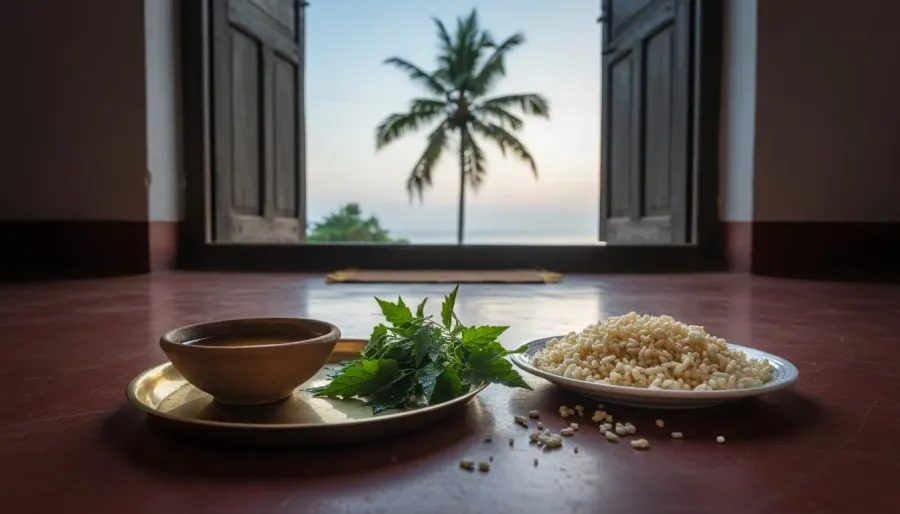
Once the effigies are incinerated between 4:00 AM and 6:00 AM, Goan households observe private Diwali morning rituals passed down through generations.
Upon returning home from the street burnings, family members crush a small, bitter wild fruit called karit (Cucumis melo var. agrestis) outside the front door using the left foot. This act symbolizes the slaying of the demon Narakasura. Before stepping inside to wash, each person touches a drop of the fruit's bitter juice to their tongue.
This is followed by Abhyanga Snan (or Abhyang Snan), a pre-dawn ritual bath. Scented oils and an herbal paste known as utna (or utnem) are applied to the skin before bathing. Homes across the state light clay oil lamps called pontis and hang colourful geometric paper lanterns called akash kandil (or akaashdivos).
The celebration moves to the table with a festive breakfast focused on fov (flattened rice / poha), traditionally prepared in several sweet and savoury variations:
- Godanche fov: Flattened rice sweetened with jaggery and infused with coconut milk
- Rosatle fov: Flattened rice steeped in freshly pressed coconut milk
- Doodhantle fov (or doodhatle fov): Flattened rice cooked gently with milk and sugar
- Batat fov: Savoury spiced flattened rice prepared with potatoes, mustard seeds, and turmeric
Safety Rules, Noise Curfews, and Traffic Advisories
Local authorities enforce strict civic and crowd-management measures across all municipal viewing areas on Diwali Eve:
Noise Control: Under the Noise Pollution (Regulation and Control) Rules, 2000, public address systems and amplified sound are restricted after 10:00 PM. On Diwali Eve, the Goa State Government permits sound systems to operate up to 12:00 midnight only for licensed venues and mandals.
Fire Safety and Fireworks: Goa Police enforce an outright ban on barium-salt fireworks and stringed crackers (ladi crackers), limiting consumer firecracker usage to specified two-hour evening windows. The Goa Fire and Emergency Services advise spectators to maintain a clearance zone of at least 15 to 20 metres during the dawn burnings, as effigies are packed with internal firecrackers and dry straw.
Overhead Cable Clearance: The Goa Electricity Department issues safety notices requiring mandals to regulate effigy heights and movement along public roads to prevent contact with low-tension and high-tension (11 kV/33 kV) overhead power lines. Hydraulic effigies exceeding standard clearance limits require Collector clearances.
Traffic Diversions: Goa Traffic Police shut inner roads to vehicular traffic and set up one-way corridors and pedestrian zones in central Panaji (including Mala and Patto), central Margao, and Vasco from 9:00 PM or 10:00 PM until 5:00 AM to 7:00 AM the following morning.
Visitor Advice: Families with young children or noise-sensitive travelers should visit static effigies between 7:00 PM and 10:00 PM. Spectators attending the dawn street burnings between 4:00 AM and 6:00 AM are advised to wear protective glasses and bring certified noise-reduction earplugs against flying embers and loud detonations.
Getting to the Viewing Hubs in Panaji
If you are travelling into Panaji to watch the effigies or participate in wider things-to-do-in-goa during the festive season, here are the core transit distances:
From Manohar International Airport (GOX) in Mopa, Pernem Taluka: Panaji is 33 kilometres south, taking roughly 45 to 55 minutes via National Highway 66.
From Dabolim Airport (GOI): Central Panaji is 28 kilometres north, a drive of approximately 40 to 45 minutes along NH 66.
From Karmali Railway Station: Located in Tiswadi, Karmali is the nearest rail station to Panaji, situated 13 kilometres to the east (about a 20-to-25-minute drive via Old Goa).
Because of pedestrian detours around Patto and Mala on Diwali Eve, vehicles must be parked in peripheral municipal parking areas before walking into the competition zones.
If you need tailored guidance on experiencing Goa's cultural festivals or want assistance planning your route, feel free to reach out to GoaWala on WhatsApp.
Book with GoaWala
56 options from ₹350 per person — live prices, October 2026.
| Experience | Price | Duration | Starts from | Free cancellation |
|---|---|---|---|---|
| Thunder World Goa | ₹350 per person | 2 Hours | North Goa | up to 24 hours before |
| Calma Sundowner Cruise | ₹400 per person | 1 Hour 30 Minutes | Panaji (Central Goa) | up to 24 hours before |
| Capital Sundowner Cruise | ₹400 per person | 1 Hour 30 Minutes | Panaji (Central Goa) | up to 24 hours before |
| Infinity Sunset Cruise | ₹400 per person | 1 Hour | Panaji (Central Goa) | up to 24 hours before |
| Kayaking in Goa | ₹400 per person | 30 Minutes | North Goa | up to 24 hours before |
| North Goa Tour | ₹400 per person | 9 Hours | North Goa | up to 24 hours before |
| Paradise Sunset Cruise | ₹400 per person | 1 Hour 30 Minutes | Panaji (Central Goa) | up to 24 hours before |
| Snow Park Goa | ₹400 per person | 2 Hours | North Goa | up to 24 hours before |
Frequently asked questions
Is viewing the Narkasur effigies free in Goa?
Yes. All roadside viewing, community street parades, and open-ground municipal effigy competitions across Goa are free of charge and unticketed.
What time do the Narkasur effigy burnings take place?
The ritual burning ceremonies (Narkasur Vadha or Dahan) occur at dawn between 4:00 AM and 6:00 AM before sunrise on the morning of Narak Chaturdashi.
Where are the best places to see the effigies in Panaji?
Patto Plaza is the primary location for mechanized and hydraulic effigies, while the neighbouring residential area of Mala hosts traditional mandal displays.
When should families with young children visit the effigies?
Families should view the static effigies between 7:00 PM and 10:00 PM on Diwali Eve, before sound systems, crowds, and fireworks peak around midnight.
What is the traditional Goan breakfast on Diwali morning?
After the dawn effigy burnings, Goan households eat fov (flattened rice), served in varieties such as batat fov (potato poha), godanche fov (with jaggery and coconut milk), and doodhantle fov (with milk).
Are roads closed in Goa during the Narkasur celebrations?
Yes. Traffic police enforce pedestrian-only zones and vehicle detours in central Panaji (Mala and Patto), central Margao, and Vasco from roughly 9:00 PM to 7:00 AM.
Sources
- dharmiklife.com
- incredibleindia.gov.in
- thebluekite.com
- goa2go.in
- picknicgo.com
- heraldgoa.in
- susegadsuitesgoa.com
- airmundo.com
- transfeero.com
- rome2rio.com
- taxibazaar.in
- cabbazar.com
- reddit.com
- digitalgoa.com
- republicworld.com
- thegoan.net
- earthstoriez.com
- gomantaktimes.com
- youtube.com
- youtube.com
Last checked 20 October 2026